Monday, June 1, 2026

ROUND 12 GAME ANALYSIS - CAR/GEE + SYD/RICH + MELB/GWS


Who would have thought the Blues could be knocking on the door of the 10? But after a complete turnaround in their game style and a couple of selection changes, here we are!

The Cats never really have to worry once they get 5 - 6 early season wins as they always have a home-dominant schedule in the back half of the season so they'll once again fine tune until September.

The Swans were never bothered by the Tigers and it was always going to look like this coming off a loss, on our home deck, against half-a-VFL team but also with 4 - 6 of our best 23 not playing in this game.

Although not defending too well, the Tigers did post the 3rd highest 1st half score against us for this season (7.4 v 8.10 and 8.8) and so it still shows that you can score against us but in the 3rd quarter a 7.7 to 0.3 scoreline told the story.

The Dees are so up and down it's hard to see where they land and it seems like the Giants have been resurrected and although will be a very dangerous play-in team, winning 5 finals has to be sitting at a less than 1% chance!

Today we look at:

  • Carlton Not Being Very Carlton-y at Kick In
  • Sydney Creating Corridor Space
  • Sydney at Center Bounce Clearance
  • Richmoind Defending Corridor Space
  • Kozzy Run
For full access to this game analyse post, register for a level 1 membership from https://aussierulestraining.com/membership-account/membership-levels/.

Sunday, May 31, 2026

FOOTY SCHOOL


During the week the article linked below was published by AFL Media reporter Sarah Black:

The AFLW skills hothouse helping clubs and players grow

In it, she describes the Skills Hothouse, a set of learning sessions designed specifically for teaching skill.

Footy School.

Earlier this year I attended the AFL Coaches Forum (posted about here and here) that sounds like exactly what they're being taught here.

What they're learning is not new in elite coaching ranks and shouldn't be new to regular readers of my content over the years, so I'll go into some more detail on parts of what Sarah is writing about.

"It was more around this notion that we could still develop a community, a practice, where coaches and players start to appreciate and share what it means to be skilled, and how growth can occur in the game."

Skill is NOT what you can do in pre-determined, unopposed cone-to-cone training drills, it's how you can adapt to ever-changing conditions and problem solve and still have a high success rate under constrained conditions.


"They're the content experts. They know what a drop punt is, and whatever else. For me, skill learning is around the conditions that create the most effective practice of the skills of the game."

To create these conditions, you're looking at representative learning design which refers to designing training activity tasks that contain contextual information that you'll find in a game - reduce without impoverishing  


"A lot of the topics we went into delved into that, going into the stronger underpinnings of learning, so then coaches can apply it however they want. Footy environments are always time-pressured, and you can always practice something and think you're going to get gain from it, when the likelihood is you won't, based on learning theory."

For everything you need to be prepared for, for a single game of footy, wasting precious time on 30mins of warm up cone-to-cone drills makes zero sense from a community football point of view, unless you're going to be as forgivable for your below-average training sessions as you are for your players' gameday performance as you expect them to adapt to the conditions of the game, yet your training doesn't reflect that in the slightest. 


"Farrow takes players through the concept of learning drills (skills practice) and performance drills (maximising skills), and ties that in with an athlete's best and worst weapon – perfectionism."

Divide your sessions or training activities within the same session, into learning and performing biased. Learning training activities are usually free play-based with players free to make their own decisions and explore different solutions they otherwise might not, and there is psychological safety around this decision-making process - a rare commodity in community football.

For performance-bias you would design tasks that will result in a high rate of success, but I would still steer away from cone-to-cone drills that lack game information and this is where true coaching craft is a must. 


"Football is a game of errors, the team who wins is the one who adapts the best," Farrow tells the players and coaches."

Sydney was a perfectionist/control-based team in previous years and have now embraced imperfection and chaos. This is also the problem with cone-to-cone drills - there is zero game information so the only thing you gauge success on is how may targets you hit and then how many is too many? They're also boring so the longer they go the more targets are missed but then that's when coaches extend it to "clean it up" = average coaching. 


"The whole game is around solving the problem that's right in front of you, at that moment."

Do your warm-up but cut it to 15mins or so then get into some low pressure/complex problem-solving as soon as you can - maximise every minute you have out there.


"The definition of skill is technique plus adaptability, divided by pressure."

Try this in your bye week. 5 - 8 mins of cone-to-cone, unopposed kicking and track every kick for a hit or miss. Then do 5 - 8mins of a small sided-game and track every kick again. Look at the data then decided what was different between the 2 conditions and how that affected the kick success rate between the 2 training activities.


"Farrow hones-in on ground balls, showing a video comprised entirely of clips of the ball on the ground from the second quarter of Richmond's loss to Melbourne last year, then asks the players to break up into small groups to discuss what they see."

Find ways to training players for their specific positions instead of everyone playing every position during training - that way they're practicing position-specific decisions with position-specific movement solutions. Watch every AFL team pre-game on-field warm-ups doing this for some easy prompts.


"There's another discussion point around "gamification", and making training fun, creating a safe environment to fail and practice skills."

Include these in your training activities - opposition, decision-making, consequence/scoring system - and you're well on your way.


"One of the things we're trying to evaluate is the impact – it's one thing to have coaches say it's great, and players have equally said they've learnt a lot, but how does that transfer? There's a couple of things," Farrow said."

99% of community footy training is very generalised with all players practicing all kicks etc as mentioned above but this only provides general results and minimal, if any, game transfer. This is from coaches simply doing what they've always done but clubs and leagues should be strongly pushing and promoting coaching upskilling opportunities. Personally, every club should have 1 junior and 1 senior coach go through an AFL-backed coaching course per year, and present their findings to their other club coaches and that somehow followed up as well to get your accreditation points. 

I implore you to give the full article a good read.  

Thursday, May 28, 2026

PERCEPTION PART 2 - CASE STUDY


Last week I posted notes from an article by Mark O' Sullivan on perception and then came along a part 2 so here's the notes from that one as well!

  • If you’ve never seen them play before then start with 15mins of 8v8 to develop your knowledge of the environment to inform you on how the session could develop and what we could amplify/dampen (co-design)
  • 1 key observation was that no matter the defense they faced, the offense always tried to build up the same way and this sociocultural constraint is promoted through their training and dictates their behaviour but it also limits how players can develop their knowledge in the game, limiting their ability to scan their surroundings and perceive opportunities to exploit
  • He wanted to help break these patterns by using a simple task design to shape players’ intentions (individually/collectively) by juggling/balancing the intentions of playing through/around/over the defending team
  • He set up 2 small-sided games with 1 team told how to defend and then see if the other team attunes to what’s happening
  • Observation showed players rarely identified the opportunity to play over when it emerged but player discussions revealed a negative connotation attached to long balls so he put a focus on the defense to defend high/limit being played around which in turn provides the off with a long ball affordance
  • They initially struggled to play long balls with accuracy from never having really trained them
  • Rather than telling players to scan more/make better decisions, the session design focused on creating conditions in which these behaviours became functionally necessary
  • There are 4 hallmarks of human behaviour
  • 1 x Agency which is where players experience themselves as active problem solvers exploring opportunities for action v following instructions + tasks designed without over explicit instruction/environments where perception and action is required to succeed + self-initiated exploration, independent adjustments, reduced reliance on coach input or hesitation when players expect direction + are players discovering solutions themselves or waiting for instruction
  • 2 x Prospectivity which is where behaviour is guided by anticipation of future possibilities emerging from the environment + tasks create situations where future outcomes matter (pressure/transition/manipulated space)/constraints that reward acting ahead of play + players acting (individually/collectively) in advance of events via moving early, anticipating passes, exploiting space as it unfolds + are players acting of the game or reacting after it unfolds
  • 3 x Seeking Order which is where players learn to pick up key information/recognise patterns in a dynamic environment + introduction of skilled intentions (through/around/over) to guide attention towards relevant information/selective tactical instructions (1 team pressing high or low) + recognise patterns (space/gaps/opportune behaviour)/more efficient decisions with less information + are players identifying/using key information to simplify the game
  • 4 x Flexibility x players adapt actions to changing constraints while maintaining their intention + continuous manipulation of constraints (space/time/pressure/opposition strategies)/varied scenarios requiring adjustment + adaptation of solutions across contexts/maintaining intent (penetrating/progressive play) with different technical actions + can players adapt their actions effectively as conditions change

Monday, May 25, 2026

ROUND 11 GAME ANALYSIS


My tipping took a bit of a hit this weekend with the upsets where I tipped 4, including Richmond.

Everything was going well until Saturday where North finally beat someone not in the bottom 5, Sydney finally losing after not looking not as good the past 2 - 3 weeks as they were previously, the Blues backing it up, the GWS 3rd quarter was ridiculous and the Dees keep having let downs after great wins the week prior.

Today is a mixed bag where we look at:

  • Sydney Forward 50 Throw In
  • West Coast 2v1
  • Daicos Brothers
  • Collingwood Forward 50 Stoppage Goal
  • Sheezel Run
  • Wardlaw Game IQ
  • Brisbane Kick Out x 2
For full access to this game analysis, register for a level 1 membership from https://aussierulestraining.com/membership-account/membership-levels/.

Wednesday, May 20, 2026

MY YEARLY JUNIOR FOOTBALL POST

Once a year I come across a polarising piece on junior football that I think deserves to be highlighted and here's this year's edition:

The OP is right, something does need to be done about this at junior level and if you're not part of the solution then you're part of the problem. 

It has 120-odd comments on it so is definitely a big issue in football so I thought I'd touch on some of the comments looking at ways to help fix this and some general comments as well.      


ON-FIELD COACHES 

I like this option and I could go as far to say that this should be available to all clubs (if they desire) up to possibly under 14's football. 

Leagues/could also use a scaffold-like set up where on-field coaching support is gradually decreased from younger to older age groups and/or from early to late in the season. 

So for u8's there can be 1 coach on field for the entire game who focuses on 1 line (forwards/mids/backs) per quarter then that decreases to 3qts, 2qts, 1 qt and then not all up to a youth age group like u14's as stated above. 

The 2nd could work the same but as the season progresses, on-field coaching does too so 4qts for games 1 - 3, 3qts for games 4 - 6, 2qts for games 7 - 9, 1qt for games 10 - 12 then no on-field coaching after that. 

This actually puts an onus on high quality on-field coaching and would most probably help clubs align their training and gameday practices to create a far more effective learning environment for all players (and coaches).   


UMPIRES ENFORCING DENSITY RULES 

I also like this one with the suggestion of putting the ball down for 7 - 10secs until players disperse being something to tinker with but I also agree that with junior football comes junior umpires and that is far too much to put on their plate. 

If the umpire rule is to do that for every ball up and then the on-filed coaches are in charge of players repositioning (if they need to), then again that's something to start with and work from.   


SCALING 

There were many comments on field size and player numbers and I agree - every age group should scaled specifically to their age group. 

There was 1 comment stating that 1 year they went from u10's half oval to u11's full oval in 1 season which is a ridiculous jump to make in such a short span of time. 

I personally think that full field probably shouldn't be a thing until at least 16 football and I'll get some splashback on that for sure. 

The younger the age group, the lesser numbers of players per team and the smaller playing field to play on (and possibly more goals to score into).      


COACHING 

There were obviously plenty of coaching tips provided but most don't really dig deep enough for mine. 

Yes, coaches need to realise that junior football is about development and learning far more than winning at all costs, and if leagues need to put gameday "rules" in push this harder then I reckon they should. 

Rotate players through all 3 lines, scatter your top players across the ground and even rotate all players off the ground throughout games are all easy things for any coach to do. 

I'm happy for zones to be a thing but not hard zones as we don't want someone chasing the ball and then just stopping at a line that says they have to. 

This could be tinkered with by allowing out-of-zone players to enter a different zone "in the line of play" and/or for a short amount of time. 

For example, for a ball in dispute that is bobbing around in no clear possession for either team, a player can follow that ball into another zone until it is cleared. 

Maybe this is 1 player only - maybe it's 2? 

Maybe it's for a short amount of time as decided by the umpire? 

This is where umpiring and on-field coaches need to work together for the good of development/learning, not goals.   


WRIST BANDS 

Something I hadn't seen before are colored worst bands for backs/mids/forwards that again can be kept track of by both umpires and on-field coaches. 

I also suspect that having something clearly visible for the actual player is a clear reminder of what position they are playing and what field area's they should be occupying for the most part.   


COACHING SUPPORT 

This is a major one and is a club. league and general football issue. 

Yes, most junior coaches are volunteers. 

Yes, a lot of them are inexperienced. 

And yes, most clubs, and most importantly leagues, have little to no support structures in place for them and both of them are at fault. 

Senior clubs are happy to have 3 - 5 paid coaches for both reserves and senior teams but where the real coaching needs to happen, at junior level, is left to volunteers with little to no experience in football. 

Junior clubs should place more expectations on their coaches to get educated and upskill, not just be happy that Sam's dad has put his hand up to coach the under 8's because no one else should. 

More females should be provided these opportunities at both genders of football too as they bring a totally different skill set then males. 

All coaches should have to go to an in-person coaching course or similar, and/or all clubs should hold one in-house that is mandatory for all coaches to attend. 

Course providers could canvass clubs beforehand and get their 3 biggest issues they are facing and then create a specific session for each club based on their current needs and of course follow ups.   


UMPIRING...AGAIN 

There was a comment for umps to call holding the ball quicker and force them to kick faster to avoid congestion, but this will only create another generation of "dump kickers" which is already a negative thing in junior football and is bloody to coach out of them when they're older. 

I think some of the other anti-density ideas above can help alleviate the congestion issue which will always be a thing if we're going to stick with young players/high numbers/full field ideology.   


COACHING...AGAIN, AGAIN 

There was also a comment on tell them this, tell them that, tell them this as well which means players will never learn as they're simply being told and will constantly default to the thing they continually do wrong, but this is a coaching issue, not a player issue. 

Training needs to be an environment that encourages exploration and the role of the coach is to create training tasks that allow them to do so that will result in positive and negative outcomes. 

Constraints can be used to create repetition of these conditions. 

For the almighty congestion issue, give teams a time limit and a passing count within their forward half they need to hit before they can score. So a team kicks the ball into their forward half. 

They now have say 20 seconds to complete 3 passes before they can try and score. 

This means that they'll need players in their forward line and they'll need them there as the ball goes into their forward half as time is ticking. 

If all players are in the defensive half then time gets chewed up as they transition from 1 half to the other. 

Lets' say there is 1 player in the forward half and the rest are at the ball. 

The kick comes out and forward marks it in the forward half. There are still 3 passes to be made before they can attempt to score but with no other teammates in the forward half, it takes the first player 10 of those precious seconds to make the first pass. 

As they're almost ready to make the 3rd pass and then attempt to score the coach blows the whistle and it's a free kick to the opposing team and play continues. 

That offensive team will now work out pretty quickly that they need to hold their forwards closer to goal. 

That's just 1 of many examples you can use to teach your players without them even knowing (explicit learning). 

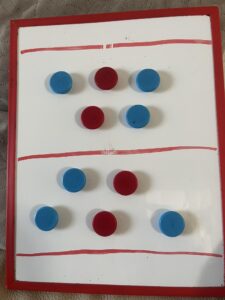
Another training option is to train in longer and/or wider spaces as players that always train in small spaces are never given the opportunity to look any further then at what's straight in front of them so any player off the line that is open, never receives the ball and then falls in line with everyone else crowding the ball to get involved in the game.

Train in long/thin, short/wide, long/wide and short/long spaces specifically with different goals for each for each. 


Offense can only kick to scoring from zone 2 so make the field long enough that they need to kick from the endline, to zone 1 and into zone 2 before hitting the scoring zone + the defense can enter the scoring zone. Offense needs to work the ball into a launch zone position (zone 2) to create the best scoring opportunity. 


Teams only have wide goals and can only score from outer zone on that side. Encourages players to look for and use wide options. 


Basically working full-field (relative) game style. How many of the 9 squares can the offense work into before scoring? The amount of squares they enter before scoring is their goal total for that goal (5 squares entered = 5pts for that goal). Enables teams to play any style they want but again exploring the full playing area will allow them to score more pints per goal. 


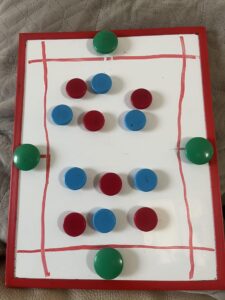
With a goal player at each end, it's a 4v3 in an area that would allow maybe 2 long kicks but the aim is to find the free player in a tight are who can then kick to the goal player. The defense cannot defend the goal player, they need to try and turn the ball over in the field of play.

That's enough for now but hopefully I've been able to give some food for thought on this never-ending issue in junior football. 

Not that I have all the answers but I think this needs a fair bit of outside-the-box thinking + clubs/league partnering to move this forward - much like everything in junior football. 

Competency increases motivation which maintains participation so as long as we're pushing for greater learning and development in players at all levels in junior football over winning games at all costs, then we're on the right track.

Monday, May 18, 2026

PERCEPTION - THE REAL GAME IQ OF FOOTBALL


When we talk about the elite players, yes we're talking about physical abilities but what leads to those is perception.

The perception of what's happening around them (knowledge in the game) and patterns of play that have happened beforehand (knowledge of the game) that enables players to perceive and process game inf0rmation in a split second and leaving the opposition, and sometimes their teammates, in the dust.

These notes are taken from an article by Mark O'Sullivan, a coach and researcher from Norway that I came across the other week -a coach I have referenced before in my posts.

  • We perceive to move and we move to perceive
  • Flashing lights/eye tracking glasses encourage observable behaviour v functional perception misleading coaches into treating scanning as a skill of head turns/gaze fixations v an emergent property of interacting with a rich/information laden environment = the appearance of scanning but without the ability to detect actionable information
  • Scanning reflects how players redistribute attention to inform action and is tracked by the frequency of head movements which only creates attentional orientation towards relevant information but it is reduced to a count of observable movement
  • Head movements, gaze behaviour and scanning are not synonymous
  • Gaze Behaviour x direction of central vision measured by eye tracking that indicates where/when an individual fixates but it does not reveal the perception of what is actually being perceived/used
  • Peripheral vision is highly sensitive to motion (an overlapping teammate/opposition pressure) and plays a huge role in dynamic environments but is not captured/tracked so looking can’t mean there’s automatic seeing
  • Head movements are easy to track but offer only indirect insight into perception
  • True scanning needs to be understood as an embodied/embedded exploratory process through which performers seek information that specifies affordances in a dynamic environment
  • More head/body movement does not mean more perception nor does fixation guarantee meaningful information pickup
  • How can environments be designed so players must search for, detect and use relevant information?
  • Scanning is not trained in isolation but emerges from engaging with representative/information-rich contexts
  • Perception is shaped by the relationship between information/action capabilities and what a player sees is constrained by what they and others can do and teammates in turn, calibrate their own behaviour accordingly
  • They can also be shaped by socio-cultural contexts
  • Scanning is an active search for information specifying actionable possibilities, being guided by task demands, individual capabilities and culturally shaped expectations about what information matters
  • Create environments where players need to search for information in order to succeed via designing tasks where relevant information may not always be available encouraging exploration
  • Don’t train scanning itself but the conditions under which effective information pickup emerges
  • Don’t improve scanning behaviour, improve the quality of perception-action coupling
  • What does the environment demand that makes searching for information necessary?

Sunday, May 17, 2026

SYDNEY v COLINGWOOD GAME ANALYSIS


A very, very interesting game Friday night between the Swans and Pies.

The Pies are THE most organised team in the AFL and with a team down on personnel, a solid plan was always going to be in place for this one, especially around taking away corridor use for the Swans, that North were able to do to good success last week.

Before I go any further into the senior game I took a look at the VFL game that was on TV against the 2 teams who probably mirror their AFL/VFL teams playing style the best and see what I could find.

What was evident early was Colingwood's defensive plan to take away corridor, a prelude to the senior game hours later as shown in the first clip.

The middle clips show the Swans VFL, bolstered by the senior team only missing 2 players, dominating in spite of that plan, rebounding from defensive 50, using corridor and having more numbers at almost every contest.

The final clip shows the Pies applying the clamps defensively on a Sydney defensive 50 rebound, following the principles of Forward Press Defense perfectly. 


Getting back to the senior game, it was again very evident on the Pies focus of taking away corridor that did rattle the Swans but as stated in the clip below and from Coxy's 1/4 time interview, the players knew what the Pies would probably try and do, had wide options to counteract that with, but just tried to force everything corridor regardless.

The result? 

Down 33 points in the 2nd quarter.

In the 2nd quarter we were able to wrestle game back to neutral, but still were down by 21pts at the half as while we took the time to fully adapt to the Pies defense, they turned us into a kicking team which is much easier and predictable to defend.

Enter the 3rd quarter and the Oscar Steene injury.

We turned a 21pt deficit into a 6pt lead on the back of 6.6 to 2.3 and some dominant 3rd quarter stats.

The Pies generated 10 inside 50's from 27 defensive chains in the 1st half v 1 from 17 in the 3rd as the Swans had total forward half field position dominance with 25 - 8 inside 50's resulting in 12 scores.

According to the best stats in football, the Swans managed 41 points from stoppage to 11 with 52 of our 81pts from the forward half, showing Grundy' dominance with 46/62 of the game's hit outs.

Sysney also managed 18 - 1 hit outs to advantage where I assume a lot of them were in the forward half that gave us a leg up to the 41pts we scored from stoppage.

In the end a win for both teams I suppose.

The Pies came with and carried a plan that gave them every chance to win and the Swans won in a completely different manner to what we have been and adjusted in-game successfully (not a usual Sydney strength).

Tuesday, May 12, 2026

BRISBANE/CARLTON + GEELONG/COLLINGWOOD GAME ANALYSIS


Funny game this one where Brisbane pulled a Carlton and Carlton pulled a...reverse Carlton!

That being said the Lions clearly took the foot off the pedal in the 2nd half but the Blues did play well, albeit for their usual 2 quarters.

The Cats have been going OK and the Pies just going but I don't think anyone saw this end result coming where Collingwood's clear inefficiencies across the ground are bottom 6 material.

Today we look at:

  • Brisbane Rebound from Defensive 50
  • The Very 1st Sighting of 2026 Football for Carlton
  • Carlton Not Continuing the Handball Chain
  • Brisbane Kick Out
  • Geelong Creating Corridor Space 
For full access to this game analysis, register for a level 1 membership from https://aussierulestraining.com/membership-account/membership-levels/.

Monday, May 11, 2026

NORTH MELBOURNE v SYDNEY GAME ANALYSIS


My local team had the bye this past weekend which worked out perfectly in actually getting to see the Swans play live in Melbourne and to top that up I was able to sit in a box directly behind the goals which was elite!

North were very good in this one, had a chance to win, but the times we were able to break through the middle of the ground we definitely made them pay.

The class of players of really the deciding factor here I reckon so that's a good sign for the Roos as their youngsters get more games into them - especially Wardlaw who is close to all non-North supporters' favourite player.

Today we look at:

  • North Team Defense Fail
  • Sydney Corridor Space x 2
  • Sydney Forward 50 Stoppage x 3
  • Sydney Adopting the Brisbane-esque Formation
  • North Taking 1 Thing Away and Sydney Adapting
For full access to this game analysis, register for a level 1 membership from https://aussierulestraining.com/membership-account/membership-levels/.

Thursday, May 7, 2026

SYDNEY v CASEY VFL GAME ANALYSIS


The Sydney Swans/Casey Demons VFL game was televised over the weekend so I thought I'd give it a look to see the level of AFL/VFL alignment in regards to game modelling for the Swans.

It's safe to say that the alignment is very good with a huge preference to handball chain through the middle of the ground to great success, much like the senior team at the moment.

 For the record both teams have lost just 1 game each this season.

This is great to see as it means when there are injuries to best 23 players, it's pretty much a plug and play for the VFL guy coming in and you can minimise the drop off in individual and team performance because if you lose a top 5 player from the best 23, you're usually replacing them with player 24 - 28 from the VFL.

2025 presented all sorts of injury issue for the Swans with the big one being Gulden where we were 6-8 without him and then 6-3 with him when he returned but so far this year we've been able to cover him and the AFL/VFL alignment foes a long way to accomplishing that.

Today we look at:

  • Sydney Creating/Utilising Corridor Space x 2
  • Sydney Rebound 50
  • Sydney Defensive 50 Throw In
  • Sydney Defensive 50 Ball Up
  • Sydney Kick Out
  • Sydney Wing Play

Tuesday, May 5, 2026

WB/FREO + ADE/PA + ESS/BRIS + SYD/MELB GAME ANALYSIS


Today we look at:

  • Bulldogs Kick Out
  • Port Creating Corridor Space
  • Essendon Defense Fail
  • Brisbane Kick Out Transition
  • Brisbane Kick Trigger
  • Brisbane Transition Offense
  • Melbourne at Center Bounce x 3
For full access to this game analysis register for a level 1 membership from https://aussierulestraining.com/membership-account/membership-levels/.

Monday, May 4, 2026

COLLINGWOOD v HAWTHORN GAME ANALYSIS


Yesterday I isolated some Nick Watson clips and today I deliover the rest of the game.

The Pies have seemed to weathered their lack-of-scoring storm, managing 88, 137 (v Blues/Essendon respectively) and then 93 against a stingy Hawthorn outfit.

18 scoring shots for 15.3 from just 34 inside 50's was a Fly masterclass as they were able to pull the back 6 apart for the Hawks and not allow Battle, Barrass and Sicily to 3rd man up intercept mark.

The Hawks let 1 slip though with 13.15 from 62 entries - 28 scoring shots to 18 - to draw so they'll be kicking themselves (but not goals obviously).

Today we look:

  • JDG Lane Running
  • Hawks Forward Press Defense
  • Houston Overlap
  • Weird Formation from Both Teams
  • Collingwood Corridor Positioning
  • Hawks Skinny Wing in Defensive 50
  • Collingwood Kick Out
  • Colingwood Rebound 50
For full access to this game analysis register for a level 1 membership from https://aussierulestraining.com/membership-account/membership-levels/.

Sunday, May 3, 2026

NICK WATSON v COLLINGWOOD GAME ANALYSIS

I had a close look at the Pies/Hawks game from the weekend and came away with 12 clips, 4 of which were of the Wizard so I'm breaking them up into 2 sperate videos.

I'm loving what he's doing this year and if you're a small forward at local level you HAVE to be watching how he goes about it.

He has pace that not everyone has but his positioning and movement patterns can be studied and replicated by almost anyone + it helps to have a coach that allows you to almost single handedly focus on small forward craft in actual games to simplify things.

What did help his cause though was Collingwood rarely locking onto him during transitional contests of which we can see in some of these videos below, and at forward 50 stoppages when they had the opportunity to do so, his constant movement caused all sorts of issues for the Pies defenders!

Check it out:

Thursday, April 30, 2026

D1/2/3 v A1/2/3 INTRODUCTORY TRAINING ACTIVITY


During the week I received a message from a local coach helping out at under 15's interleague level.

He was after something to teach D1/2/3 specifically as he has found that not a lot of them are even aware of the concept so he wanted to introduce it to those who hadn't and to build on the current knowledge of it for those that had.

I sent him the easiest way I know how to introduce the concept with a quick video each for A1/2/3 and then a separate one for D1/2/3.

The defense you're up against more than likely dictates the offense you can/need to use so I'd teach the defensive side of this first and keep the focus on that specifically - literally coach the defensive players in the activity and let the offensive players run free...

For full access to these training activities, register for a level 3 membership from https://aussierulestraining.com/membership-account/membership-levels/.

Tuesday, April 28, 2026

ESSENDON/COLLINGWOOD + BRISBANE/ADELAIDE GAME ANALYSIS


The Bombers went full Essendon in the 2nd half Saturday, giving up 15 goals to 6 against a low-scoring Collingwood outfit after a couple of pretty solid showings but that's the inconsistentcies of a young team for ya.

The Pies were always going to be too professional against the Bombers with their elite organisation around the ground but I think they'll come back crashing to earth against the Hawks Thursday night.

At times, the Lions seem to breeze through games and then once-a-month just remind everyone who they really are and what you'll be contending with in August/September.

The Crows haven't really dealt with their ball movement issues from last year and being 13th placed with the 7th worst offense is a testament to that.

Today we look at:

  • Colingwood at Center Bounce Clearance x 5
  • Colingwood Creating Corridor Space
  • Brisbane on Kick Out
For full access to this game analysis, register for a level 1 membership from https://aussierulestraining.com/membership-account/membership-levels/.

Monday, April 27, 2026

SYDNEY/BULLDOGS + HAWKS/GOLD COAST GAME ANALYSIS


The Swans are flying at the moment which concerns all us Sydney supporters as we've seen this story too many times before, yet this does seem different as we're doing without Gulden (which we couldn't do last year), and didn't see much of a drop off without Heeney this past weekend either, albeit against the Dogs reserves!

The Dogs are going to just have to try and hold on for the next month or so until they get their troops back with Freo home, Port away, Carlton and Melbourne home so they should be OK in the short term but it's hard to ee them really contending without Darcy as Naughton is your classic 2nd forward.

The Hawks are flying as much as the Swans are and winning in a variety of ways like they did last year with a 34 and 21 year old doing a lot of damage up forward for them along with their rock solid defense.

The Suns are struggling at the moment and even with Trac, Anderson and Rowell, are losing clearance (16th for clearance differential before this round and lost them again by 3 in this game.

Today we look at:

  • Sydney Going Corridor x 2
  • Collingwood at Center Bounce x 5
  • Wizard Small Forward Craft
  • Hawks Going Corridor
  • Walter Work Rate
  • Gold Coast Creating Corridor Space x 3
For full access to this game analysis post, register for a level 1 membership from https://aussierulestraining.com/membership-account/membership-levels/.

Wednesday, April 22, 2026

GOLD COAST/ESSENDON + MELBOURNE/BRISBANE GAME ANALYSIS


The Coasters are up and down a bit at the moment but with Anderson, Rowell and Petrecca yet to play and gel together, I think they'll be OK in the long run and the gaps they seem to have right now will be wall papered over with midfield class.

The Bombers have had a relative resurgence of late with the 2nd half v the Bulldogs, the win over Melbourne, and then another solid performance v the Suns here. The definitely have a talent upgrade on recent times so time is the key here, but some encouraging performances can never hurt a club or its fanbase.

The Dees are 2 different teams at the moment but their run and gun offense feeds this as there's so little room for error and those errors can go straight to the scoreboard very quickly but I they're great to watch.

The Lions look like they're struggling but are actually in a similar spot as they were last season (3-3 @ 111.7% this year with 1 home game loss v 4-2 @ 105.7% last year with 1 home game loss), but 2nd v 9th on the ladder but they'll be there when the whips are cracking.

Today we look at:

  • Kako - What's Next?
  • Gold Coast at Center Bounce Clearance
  • Brisbane Patient With Ball in Hand
  • Brisbane Missing Open Option Going Inside Forward 50
For full access to this game analysis, register for a level 1 membership from https://aussierulestraining.com/membership-account/membership-levels/.

Tuesday, April 21, 2026

SYDNEY v GWS GAME ANALYSIS


The Swans keep rolling on sitting on top of the ladder with a 30% difference between them and 2nd spot Freo while being 1st in points for and 2nd for points against coming up against a potentially injury ravished Bulldogs Thursday night.

GWS, themselves injury ravished but over a much longer stretch, just haven't had the cattle to compete against anyone really and will probably be the theme until next year once Tom Green comes back, or at least their defensive pillars.

Today we look at:

  • Sydney Creating and Utilising Length Through the Mid 50 x 4
  • Lloyd Wing Run
  • Sydney at Center Bounce Clearance
For full access to this game analysis, register for a level 1 membership from https://aussierulestraining.com/membership-account/membership-levels/.

Monday, April 20, 2026

CARLTON/COLLINGWOOD GAME ANALYSIS PART 2/2


Usually, I'm watching games on some form of delay as I'm never home when they start which allows me to fast forward through them a touch but with a soleus strain during the game Friday night and the resultant icing I needed to do for it coupled with being unable to drive to the reserves/senior game the next day because of said soleus strain, I was able to take my time watching the replay of Carlton/Collingwood at that time.

The Blues are a must-watch purely for the fact they lead every game and then find new and exciting ways to cough up that and not be able to hold on.

Like I said yesterday I don't really do positive/negative analysis - it's more around game patterns that you can use as coaches at local level but this Carlton run has so many glaring errors I can no longer ignore them!

Today we look at:

  • Williams Going Kick Over Handball
  • Carlton Lack Structure During Offensive Fast Play
  • Evans Not Protecting the Back
  • Harry Not Hard/Low Enough
  • Walsh Losses Daicos
  • Blue Mids All Too Close
  • Newman Too Loose
  • Jagga Too Slow to React
For full access to this game analysis, register for a level 1 membership from https://aussierulestraining.com/membership-account/membership-levels/.

Sunday, April 19, 2026

CARLTON v COLLINGWOOD GAME ANALYSIS PART 1/2


Another week of the exact same from the Blues - half/three quarter time lead and a loss - against Pies team that's just going with multiple best-10 players missing.

This game is broken into 2 with today showing some positive clips (mostly Colingwood) and tomorrow being negative clips (all Carlton).

I don't normally analyse games like this, but I watched this one from start to finish without distraction so I noticed a lot going on as the Blues fell into their weekly 2nd half stupor.

Today we look at:

  • Collingwood on Kick Out
  • Pies at Center Bounce Clearance x 2
  • Nick Daicos Draws 4
  • McGovern Run

For full access register for a level 1 membership from https://aussierulestraining.com/membership-account/membership-levels/.

Wednesday, April 15, 2026

20 NEW STREAMLINE TRAINING ACTIVITIES


The latest post in this series cover training activities #222 -  240 and as usual there's only a quick explanation, no diagrams or images.

#222 - TACKLING

#223 - TACKLING BAGS

#224 - PROTECT BALL

#225 - FINISHING WAVE 

#226 - WALL PASS RONDO

#227 - GOAL TO GOAL

#228 - TEAMS IN TEAMS

#229 - PRESSING VICTIM

#230 - 5v5 + 4

#231 - 6v6 + 2

#232 - TIEBREAK

#233 - 3 TEAM TIMER

#234 - DEFENSIVE SHAPE/POSITION

#235 - ROLE PLAYERS

#236 - END TO END RONDO

#237 - FAST ATTACK

#238 - 3v3

#239 - 2 x 4v3 RONDO

#240 - TRI COLOR GAME

For full access to these training activities, register for a level 3 membership from https://aussierulestraining.com/membership-account/membership-levels/.

Tuesday, April 14, 2026

ROUND 5 GAME ANALYSIS - ADE/CAR + COLL/FRE + HAW/WB


Same old story for the Blues which is a cannot-stop-watching trainwreck at the moment because no matter how good they are early, we know it'll fall apart later. 

The Crows really need this win to stay in touch with the top 8 (can't bring myself to say top 10 yet!) but they're anti-2026 brand of football just doesn't look like it's going to worry the big guns throughout the season but we'll see what difference Dan Curtain makes when he returns to pass full judgement.

The Pies and Dockers was an absolute snooze-fest! The weather wasn't super but other teams played in the same weather and easily surpassed the 24 total scoring shots these teams combined for. The Pies have the 2nd least total points for so far, only behind an anaemic Richmond with their 3rd best defense the only thing keeping them in games at the moment even with a favourable draw so far.

The Dockers are still trying to consolidate their run and gun game so a team like the Pies were always going to have them default back to slow ball movement but that's on the Dockers for going to conservative and might be a hindrance in the pressure cooker that is finals footy.

The Lions again puff the chest out for 5 - 8mins and get over the line while North actually showed more in this game then their wins but their under 10 skill errors still hold them back from making the huge strides their trying to make. 

The Hawks are the in-form team right now for mine after beating Sydney, Geelong and the Bulldogs 3 weeks in a row BUT all 3 of those teams were down in personnel through injury which does bring midfield depth back to even for the Hawks so let's see them against a top 5 midfield at full strength before restructuring the mortgage on them. 

Today we look at:

  • Carlton Trying to Play 2026 Football
  • Colingwood Forward Press Defense
  • Colingwood Kick Out
  • Brisbane Kick Out
  • Brisbane Going Corridor x 2
  • Hawks Width 

For full access to this game analysis post, register for a level 1 membership from https://aussierulestraining.com/membership-account/membership-levels/.

Sunday, April 12, 2026

SYDNEY v GOLD COAST GAME ANALYSIS


If you're a regular reader/watcher of my game analysis posts then you'll be well aware of the teams like Sydney, Gold Coast and Brisbane creating length through the center of the ground for to move the ball through the corridor whole getting your forwards deep inside forward 50 at the same time.

Leading up to the Sydney/Gold Coast game I posted about how both teams both want to this mid50 length from contest, who would be able to do it the best and will the dimensions of Norwood allow it to happen?

In the end the deciding factor was pressure and tackling.

Over 45 games so far this year, 15 have had a +10 tackle differential with 8 of those having a +20 tackle diff.

Only 1 of those 8 games has had a +30 or more tackle differential and it was this very game, where Sydney were +45 in tackles with an almost 2:1 tackle ratio (97-52).

Post-game the Swans' players said this was a focus which I presume was based on the ground dimensions (narrowest ground in the AFL) = less ground to cover per defender = more congestion = high pressure/tackle which also helped the Swans limit the Suns to 0 contested marks for the entire game.

On top of that the Suns had 13/14 lowest rated players on the ground v Sydney having 7/8 highest rated and to get back to the tackle factor, Gold Coast had 19 players with 3 or less tackles for the game v Sydney with 7/8 highest tacklers for the game. 

Cox thoroughly outcoached Dimma in this game.

This video is sorted into 2 parts:

  • The first 12mins looks at both teams creating m50 length from center bounce clearance, general play stoppage and kick outs
  • The last 3 mins looks at Rowell losing Heeney, Sydney Forward Press Defense and Grundy Ruck Run
For full access to this game analysis, register for a level 1 membership from https://aussierulestraining.com/membership-account/membership-levels/.

Wednesday, April 8, 2026

WESTERN BULLDOGS/ESSENDON + HAWTHORN/GEELONG GAME ANALYSIS


The Dogs could have made an awful mess of the Bombers but a late scratching for Richards and a 2nd quarter injury to English allowed an Essendon comeback of sorts for an 8-2 goal 2nd half to the Bombers.

Nothing to worry about for the Dogs who were probably looking ahead with Hawthorn this week and if Essendon want to be taken seriously then they need to be able to hang with teams when they're not in 2nd gear.

The Hawks are winning like last year but you just feel they're a rung below the other top teams and it seems like the Cats might be as well this year but both teams fielded a lot of 1st and 2nd year players so a little dip before another rise is probably on the cards for both.

Today we look at:

  • Dogs Team Transition Defense
  • Essendon Outnumber Advantage Fail
  • Wizard Forward 50 Stoppage Goal
  • Geelong Length
  • Hawthorn Corridor Width
  • Hawks at Center Bounce Clearance
For full access to this game analysis, register for a level 1 membership post from https://aussierulestraining.com/membership-account/membership-levels/.

Tuesday, April 7, 2026

WEST COAST v SYDNEY GAME ANALYSIS


I expected a touch more from the Eagles in this one winning 2 games in arow and on their home deck but just shows the chasm between the top and bottom teams at the moment but that's not a change from any year we've had up until now.

The forward handball game from the Swans at the moment is going a ridiculously high level, with total meters gained for the match being 6,648 v 5009 Sydney's way.

Although we took far too long to embrace the handball game even with players perfectly suited to it, it's good to see us use it now when it can be fully taken advantage of with the new/old stand rule.

The Eagles have a clear game style which is hard to say for a lot of other younger teams so they'll be alright but until the kids can play at 100% intensity for 100% of the game, they'll still get opened up like this from time-to-time but they're on the right track.

Today we look at:

  • Sydney at Center Bounce Clearance x 4
  • Heeney Inside Forward 50
  • Sydney at Forward 50 Stoppage
  • Syndey Handball Receives
For full access to this game analysis post, register for a level 1 membership from https://aussierulestraining.com/membership-account/membership-levels/.

Monday, April 6, 2026

BRISBANE v COLLINGWOOD GAME ANALYSIS


 Today we look at:

  • Collingwood Team Defense
  • Morris Leading Patterns
  • Collingwood at Center Bounce Clearance
  • Brisbane Taking Collingwood's Eyes
  • Brisbane Forward Press Defense
  • Schultz Ball Watching
For full access to this game analysis, register for a level 1 membership from https://aussierulestraining.com/membership-account/membership-levels/.

Tuesday, March 31, 2026

ROUND 3 GAME ANALYSIS - STK/BRIS + ESS/NM + CAR/MELB


The Lions are somewhat up against it after playing 23 games or more per season and going deep into finals for 5yrs now but it's come at the best time so I've no doubt they'll stay afloat during this injury-ridden time period and then be fine come the back end of the season.

The Saints season has not started like they wanted and although I'm not too up in arms about their off-season investments, they've already lost to 2 teams who are fighting for similar ladder positions come the season's end (Collingwood/Melbourne) + an undermanned Brisbane team at Marvel meaning they're going to have to win some major upsets going forward.

The less said about Essendon/North Melbourne/Carlton the better and I like the Demons this year but they're a play-in team at best although almost a must-watch team now with Kozzie Pickett about to have a NAS-type season.

Today we look at:

  • Brisbane Getting Length
  • Brisbane Multiple Options that Draws the Defense
  • Brisbane Hit Up Lead + Length
  • Essendon Outnumber Advantage Fail
  • Cripps Stoppage Goal
For full access to this game analysis post, register for a level 1 membership from https://aussierulestraining.com/membership-account/membership-levels/.

Sunday, March 29, 2026

ROUND 3 GAME ANALYSIS - GEE/ADE + COLL/GWS


Not that anyone wants to be peaking in round 3 but there's a lot of teams with high expectations just getting by at the moment.

Geelong have been flogged by Gold Coast, had a huge come from behind victory over Freo and this past weekend just got over an offensive-allergic Adelaide but they're also blooding youngsters like O'Sullivan, Dempsey, Wiltshire, Neale, Edwards, Humphries, Bruhn and Clarke.

Adeliade have not got the memo for playing AFL footy in 2026, reaching scores of 93, 88 and 60 from an inside 50 count of -32 over the season. It's too slow and they're really missing Dan Curtin who can win 1v1's through the middle of the ground at 197cms but they need to really shift their philosophy around ball movement. For what it's worth I had them sliding this season anyway.

The Pies are boring at the moment but winning is winning and defense will keep you in almost every game you play but you need both sides cause they're not the come-from-behind types they used to be, no matter how much the TV commentators tell us they are. How they can defend teams like the Suns and Dogs to half their score while scoring above their own average remains to be seen.

GWS have been fighting the injury battle for months already and although I like their kids, they still are too thin through the midfield which can't be hidden with key defenders and forwards out of the team. If there's a great time for around 4 bye, then it's now for the Giants.

Today we look at:

  • Adeliade on Kick Out
  • Adeliade Outnumber Advantage Fail
  • Pendles Kick to Advantage
  • Collingwood High Defensive Press
  • Weird Nick Daicos Run
  • Pies Forward Press Defense
  • Colingwood at Center Bounce Clearance
  • Pies Teasong Distance
For full access to this game analysis post, register for a level 1 membership from https://aussierulestraining.com/membership-account/membership-levels/.

Thursday, March 26, 2026

WHAT'S MISSING FROM THE HAMSTRING EPIDEMIC DISCUSSION?


Over the first 3 rounds, AFL footy has undertaken very noticeable changes in how the game isa currently being played.

Whether this will hold is not entirely clear but the rules have been altered to do so at some level and a good amount of player damage has already been done with an extremely high risk of secondary occurrences of hamstring injuries after the initial one - poor Callum Ah Chee is on his 3rd since Xmas already! (cue the image from Useless AFL Stats!)

The talk of the game dramatically speeding up, the early start to the season and players not having enough pre-season training time are all a big part of this discussion and will be part of the solution - if the AFL wants one.  

For a multi-faceted sport like Aussie Rules, it needs to be looked at through a multi-faceted lens.

I like to use the 4 co-actives of performance to do this:

  • Tactical
  • Physical
  • Technical
  • Psychological

Tactically, we can clearly see the shift in play with a lot less stoppages and more continuous play.

This tactical shift can have an effect on the physical co-active as with more high-speed running comes more fatigue - low/medium speed running won't really shift fatigue markers in elite athletes.

The next flow-on effect is to the technical co-active as with fatigue comes sub-optimal movement patterns and players can overreach from less-then-stella positions.

But what about the psychological co-active?

Why has this not been mentioned at all?

It's definitely a black hole in daily media reporting as it's not visible and cannot be tracked by Champion Data and alike.

Enter Cognitive Overload.

Cognitive Overload occurs when a players' working memory gets overflowed by information from the environment which occurs in high pressure situations with great consequences.

In 2026 the game is far more open with tackles, clearances, ruck contests, ball up/throw ins, repeat stoppages all down with disposals, meters gained, marks all up.

More open play = More information to process = Less time to decide and execute in

Less stops in play = Less in-game rest = More high-speed running under relative fatigue

Cognitive Overload is definitely playing a part in this as well and couple that with dual tasking (performing multiple tasks at once) and attention can be pulled in too many directions, adding to this cognitive overload even more.

The simplest way I can describe cognitive overload in terms is through practice games and/or round 1.

Practive games are the hardest games from a physical standpoint as it's usually your first bout of continuous contact and has far closer game-simulated running then any training game can have.

You can do all the running you want but it doesn't compare you for the contact and 3 - 4 decent tackles can take the stuffing right out of you. 

Round 1 is different all together and although you've had the contact in the practice games, what you haven't had is the extreme level of arousal and this another major component to cognitive overload and is why it seems you haven't even trained once 7 - 10mins into the 1st quarter of the 1st game.

Even AFL teams struggle with this as players are always saying practice games aren't even close to the real stuff, much like training game-sim isn't even close to the practice games.

There's a lot of focus on running loads and the like and I don't know if they do already but if they don't, then AFL teams should try looking at interaction load and how many at the ball, near the ball and far away from the ball decisions are made by players and try simulating that at training along with the running demands they already know about.

Soccer has some software around this sort of thing I believe, and I'd be surprised if something similar wasn't being used in the AFL to some degree.

Wednesday, March 25, 2026

WESTERN BULLDOGS TEAM DEFENSE


The Dogs had 1 weird season in 2025.

Despite scoring the most points in the league and the 8th best defense, they still couldn't make finals, going 2-9 against the other top 9 teams.

Unless you're a bottom 6 team playing the top 6 - 8 teams maybe 4 - 5 times a year, then not beating any of them won't allow you to ever make finals and you'll forever be stuck in the middle.

In 2025 they beat 3-borderline finals teams by 11pts or less (Carlton by 8, Sydney by 11, Melbourne by 6) while losing to 6 top 8 t4eams by 15pts or less (Colingwood by 6, Gold Coast by 14, Geelong by 14, Adelaide by 11, Brisbane by 10 and Fremantle by 15).

Going into 2026 it was all about what their defense would look like and can they beat the top teams.

After not bringing anyone in specifically to shore up the backline, it didn't look promising from the outset until we saw them in action.

It's not like they need to drastically do anything defensively as they were OK last year but they needed to find a way to be better against the better teams during transition defense.

So far in 2026 they're averaging only 5pts more than last year and allowing 3 more points against but have a 3-0 record and already having beat probable top 8 teams in Brisbane, GWS and Adelaide with 2 of those being away games.

They won 8 games by 72pts or more last year and with an improved defense I shudder to think what those scores will be in 2026! 

I made a quick 5min video detailing what the Bulldogs are doing which is nothing ground-breaking but it works for their playing group rather than the players having to fit the system and requires excellent discipline in spacing.

From a local football point of view, there are many times where you'll be outgunned in 1v1's in your forward 50 and something like this could help you tremendously such is its simplicity.

The main points are:

  • Pressure at the Source
  • Delay the Opposition
  • Crowd the Corridor
  • Stay Connected
For full access to this coaching article, register for a level 1 membership from https://aussierulestraining.com/membership-account/membership-levels/.

Tuesday, March 24, 2026

ROUND 1 GAME ANALYSIS - NM/PA + STK/MELB


I thought I posted this last week but hence, I was incorrect so here it is!

From these 2 games we look at:

  • Port Forward Not Reading the Game Cues
  • North Outnumber Advantage Fail
  • Saints Getting Width But Can't Fully Utilise the Corridor
  • St Kilda Forward 50 Throw In Goal
  • Melbourne at Center Bounce Clearance x 2

For full access to this game analysis post, register for a level 1 membership from https://aussierulestraining.com/membership-account/membership-levels/.

Monday, March 23, 2026

ROUND 2 GAME ANALYSIS WEST COAST v NORTH MELBOURNE


North will be North won't they?

Given, potentially, the bottom 5 teams in their 1st 6 games, the AFL set them up to start with momentum and then see what they can do with it.

Losing on just the 2nd game to the Eagles certainly put a stop to that, at least for the time being. 

The Eagles have been slowly revving their game style up to that of Andrew McQualter and even though the results haven't been there, their KPI's to how they want to play definitely have.

Pressure, ground balls, forward surge and territory is their blueprint - taking a huge leap out of the Richmond playbook through their premiership years, and now it seems some of their draft picks seem to be coming along for the ride.

West Coast still might finish 2nd bottom this year, and they'll be better than their record actually suggests I reckon, but North must be very disappointed to allow a 60pt turnaround in this game - and so they should be.

The dominated hit outs 54 - 27 but only marginally won clearance 46 -37 and once it turned into a chaos game, then North will be North.

Today we look at:

  • North Kick Out Fail
  • North Not Even Looking to Go Forward
  • North Missing the Essy Open Options
For full access, register for a level 1 membership from https://aussierulestraining.com/membership-account/membership-levels/.

Sunday, March 22, 2026

ROUND 2 HAWTHORN v SYDNEY GAME ANALYSIS


She was a fast start to this one with an 11 goal 1st quarter with Sydney getting the game to look like they wanted it to, scoring 3.1 from turnover and another 3.0 from clearances (8-5).

After that though the Hawks made all the adjustments that mattered and just took it away from the Swans ending with +64 possessions, +43 marks and their back 6 having 46 intercept possessions showing out very poor efforts going forward.

Today we look at:

  • Hawks Not Pressing Forward Defensively
  • Sydney Inside 50 Boundary Throw In
  • Sydney Cutting Off Hawthorn Width
  • Sydney Outnumber Fail
  • Sydney Kick Out
For full access to this game analysis, register for a level 1 membership from https://aussierulestraining.com/membership-account/membership-levels/.

Monday, March 16, 2026

ROUND 2 GAME ANALYSIS - WB v GWS + SYD v BRIS


The Dogs look outstanding with a better defense but their offense is also better than last year which is a truly frightening prospect.

The Giants are going to be inconsistent this year with the outs they have the young replacements they have in instead, at least until some of those injured players get back anyway but the Dogs under the lid could be the hardest trip in the AFL this season.

The Swans were looking as good as the Dogs until the news of Gulden's surgery and 3 - 4 month recovery time came through although our revamped game time and development of some players from the injury-riddled part of last year has me thinking we can handle his loss better the 2nd time around.

Injuries are the theme today it seems as we come to the Lions, missing 7 - 8 of their Grand Final team from last season in the early part of the season and no one's depth can withstand that and they've played the 2 best teams so far in the 1st 2 rounds so they'll be fine I suspect.

Today we look at:

  • GWS Half Forwards 
  • Dogs Transition Offense x 2
  • McInerney Defensive Mid Duties
  • Sydney at Center Bounce Clearance
For full access to this game analysis post, register for a level 1 membership from https://aussierulestraining.com/membership-account/membership-levels/.

Sunday, March 15, 2026

ROUND 2 GAME ANALYSIS - THE MOST IMPORTANT SPACE IN FOOTBALL TODAY

AFL in 2026 has come with a bunch of rule changes but also with a shift in how teams are moving the ball on offense.

Yes, the stand rule allows for play tempo to be maintained but teams are already on the run anyway, they're now just more confident continuing to go fast and not hold the ball up. 

The biggest change for mine has been the use of handball through the center of the ground that some teams were doing previously (GWS/Hawks especially with their high half forwards) but it is widespread now and in a variety of ways.

Last week I highlighted how Sydney were using space through the center of the ground and I doubled-down on watching for it this round and it was pretty clear at times.

Like most tactics/strategies, once you see it you canlt stop seeing it!

Today we look at the following teams and how they are using the most important space in football today:

  • Western Bulldogs
  • Sydney Swans
  • Gold Coast Suns

For full access to this game analysis post, register for a level 1 membership from https://aussierulestraining.com/membership-account/membership-levels/.

Monday, March 9, 2026

DESIGNING TRAINING ACTIVITIES STEP BY STEP

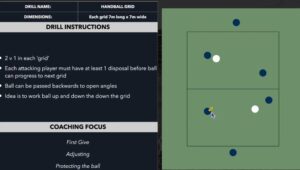
Coach AFL just put this up on their Facebook page today - a training activity (we've got to move on from drills that are predetermined and based on routine - language matters!).

They've been dormant for some time but have fired back up of the back of the Coaching Forum but it should never stop delivering to community coaches.

Here's the training activity:

The Positive's:

  • All players are involved all the time - no cones, no lines, no standing and watching 
  • It contains information that represents the game - direction, ball, teammate, space/time constraints
  • Low complexity - the offense will have at least 1 clear free player to kick to at any given time, whether that's the other player in the middle area, the end line player or a player in the next half

The Negative's

  • There is no regression or progression to the activity
  • It provides a hard rule of having both players in the middle area at 1 end having to touch the ball before it can go to the other half which doesn't open up more options, it limits them, and that goes against what happens in games.

Pretty much every training activity I see, and that includes a lot of them I saw at the Coaching Forum miss maybe the most vital part of designing training activities - affordances.

Affordances are opportunities for action.

You receive the ball and there's 1 player covered and 1 wide open - the affordance for action is to play to the open player...but what if defensive pressure is closing in on me? That affordance for action is not as strong as it would be if there wasn't any defensive pressure.

In front of me is space, space that I can run and carry through and get away from that defensive pressure.

I now have 2 affordances for action - kick or run and carry.

What training must focus on is on players being able to recognise these affordances in game-like situations and it's that decision making process that carries over into games.

If you're coaching from the sidelines and telling players to kick the ball as soon as they get it, they will never see the affordance of an open player or space to run and carry through, really putting the onus of player development squarely on you, the coach.

The hard and fast rule of both players having to touch the ball takes away affordances the initial player might have which is to keep playing forward once they receive, rather than looking sideways or backwards to make sure everyone gets a possession. 

A better way is to add a scoring system around this so if each player can touch the ball before transitioning then award 2pts for every transition v 1pt for a transition where they don't.

This keeps both options, and most importantly all affordances, open to be used as the ball carrier sees fit. 

Here's what I would do with this to make it a more complete training activity by building this out.

First, I need to settle on my intention and that can be the coaching focuses on the original image - first give, adjusting and protecting the ball.

I've never been sold on first give/first option as it's only the 1st option, it's not always the best option.

I'd possibly shift to a draw the defender towards you and then give and possibly keep it at that to really narrow the focus.

Alternatively, you can run at the defender if they are sagging off and make them focus on you, freeing up your teammate as well.

Going back to my Coaching Forum report from last week, let's use the concept and sill framework from Austin Stubbs.

The concept is drawing the defender and how to do that initially (wait for them, run at them, deceive) and the skill is the handball to your teammate (which hand to use, footwork, execution, outcome) 

This might translate to only handball when the defender is within 2m of you and then seeing how they go about achieving that - you don't want to give the answers if they can learn them themselves which has greater learning retention then simply being told.

What might end up happening is a that the ball simply moves in a clockwise fashion as the defender will possibly always be a step behind being so disadvantaged. 

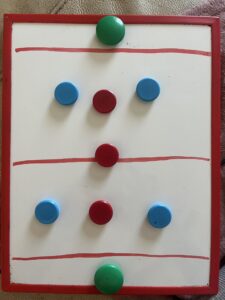
To break this pattern up add a defender to the half-way line where they can go from side to side but must remain on the line - the ball will now have to be moved diagonally at some point.

My next step would be to bring those end players into the activity and bring in another defender so it will now be a 3v2 in each half and you can make a handball count before the ball can be passed to the opposite end

Again, I'm still staying with my original intention and the cues around it - don't go away from them, keep the focus narrow.

Another aspect you can add in is that 1 player from 1 half can run and carry the ball into the other half to again open up the affordance of run and carry if it's there, and once they pass off then they simply return to their original half.

I don't do laps - unorganised coaches send players on laps.

To make organisation easy during the session think about how can build out your first training activity into something else in minimal time.

In this case we can add kicking into this by simply extending the playing area and shuffling a few players around.

Let's keep the 3v2 in each half but then add back in the end line player but also some neutral wingers.

The end line player can cover the width of the end lines to receive and the wings can cover the entire length lines to receive.

Each end is now essentially a 5v2 which is a low complex way to start.

As we've moved to kicking then the intention has to change but it doesn't need to be turned upside down as the same concept as before can be used with different cues.

In a possession game you want to move the defenders which is done by moving the ball.

With the stand rule back in effect you really want to make that defender have to stand, so you now take them out of the game until you've kicked the ball - this could be your intention: make the defense stand the mark.
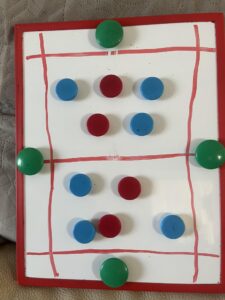
Once you've forced them to that then moving the ball will be pretty easy as there's only 1 defender to cover 4 players.
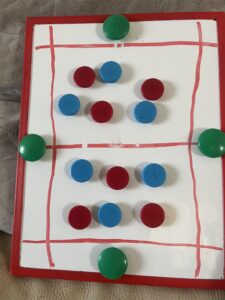
Pretty quickly I'd suggest adding another defender to each end and possibly extending the area again as we still want kicking success.

A rule might use here is that only middle players can transition the ball to the other end, either to the middle and outside players or only the middle players.

Each layer slowly increases the complexity of the training activity which keeps your players on high alert, engaged and solving problem after problem and using the variability of repetition without repetition to do so.

Finally you can take the half-way line out and play 10v6 end to end full field.

Double finally you can then add more defenders in but if offense is your intention, then keep it a +1 or 2 on offense.