AUSSIE RULES TRAINING

AUSSIE RULES TRAINING & COACHING ARTICLES / PROGRAMS / DRILLS

TAKE YOUR FOOTY TO A LEVEL YOU NEVER KNEW YOU HAD

IT'S HERE!! aussierulestraining.com

Monday, August 11, 2014

Velocity Based Training - How To

The most precise way to measure velocity is with a little something called a Linear Position Transducer sold through a website called GymAware. I am not an affiliate of these guys nor do I have one as they are a little costly but the principle is very important one in regards to athletic performance.

It's not as simple as this but what this little fellow does it attaches to the bar and measures the speed at which you lift it.


You may have seen force plates used before in vertical leap tests which is a similar thing but the LPT can be used to measure just about any exercise you want, not just ground based exercises.

As I understand it it doesn't measure power or speed but rather the displacement or distance of the chord that gets pulled from the machine. 

When combined with time, you can then calculate velocity and all equations after that, such as force and power are calculated against the system of mass (of the load or the athlete).


Now unfortunately you can only measure velocity with these machines which you may be thinking is a waste of post, what can I do with this?

I've posted about auto regulating training before and this is what these machines do. For example if you are wanting to train speed strength for a particular exercise, then from a couple of posts ago you would need to train at a speed that covers 1 - 1.5 meters per second. 

Getting instant feedback from a machine like this means that after each rep you knowing exactly what level you need to reach and it also provides a specific form of feedback that can actually enhance your training sessions because you will have a specific aim to reach each rep.

The big picture of this velocity stuff I've been blabbering on about is 2 fold.

1 - varying rep and load for specific exercises can train specific strength qualities which is essential for footy players who need to cover just about the entire force-velocity curve somewhere in their training

and;

2 - auto regulation of your training which is something I have touched on before and will be the subject of my next post and is CRUCIAL to footy players who must train for a lot of things during a full season without training yourself into the ground.

Monday, July 28, 2014

Velocity Based Training

In the last couple of posts we've looked at Force - Velocity curve (separate links for force and velocity there) and its implications in regards to program design.

In the last post there was an image that showed what spectrum of the force velocity curve you train at certain %'s of your max.

So you might be thinking "I already do train in some or all of those %'s, so I've got this covered."

Not so fast chief!

The force velocity curve is only valid if you are lifting with maximal acceleration, or at least the intent to lift with maximal acceleration, and as discussed in my previous post, most players lift more like bodybuilders, not power athletes.

So here's another image for you:


As you can see there are actually measurements needed to be reached to ensure that your are actually training in the force velocity spectrum that you intended to.

Looking at the graph you can see what most people would expect, that the heavier the load (or higher the force), the slower the velocity and vice versa.

So if you do a 1 rep max but that 1 rep takes you a full 8secs to grind out, then is that the best exercise or, implementation of that exercise, to transfer over to your sport? Probably not. There's no situation on game day that gives you 8secs to fend off a tackle of gather yourself to jump for a mark in footy!

On the other hand do those 20 rep sets performed at 50 - 60% of your max have a good chance of transferring to your on field performance? Again, probably not.

You've got to abide by the meters per second lifting range of motion number that corresponds to the force or velocity quality you aim to train for.

Next up: Ways to Implement VBT

Tuesday, July 15, 2014

The Force - Velocity Curve Part 2

Just over a week ago I posted about the force velocity curve and gave a very basic insight into what it is so
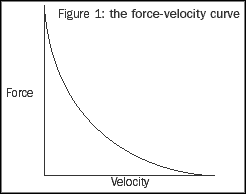
a quick recap is that one axis is force, or the heaviest load you can move irrespective of time and the other axis is velocity, or how fast you can move a given load.

So lets break the "curve" down a little shall we?

image0

Now as you can see there are various strength qualities that you've probably never heard of or even trained for (on purpose that is).

Max Strength refers lifting loads that are 90- 100% of your maximum so we're talking max bench press attempts and lifts of that nature. Car pushes is another example here for "other" max strength related activities.

Strength Speed refers loads moved in the 80 - 90% range of your max so the force requirements is a slightly lower that will equate to slightly greater velocity outputs. So it's a submaximal effort here but at a relatively high load still like an Olympic lift.

Speed Strength refers to loads moved in the 30 - 60% range of your max so now your essentially using a 50% split or close, of strength and velocity during these activities like a resisted sprint or plyometric exercise.

Max Speed (or velocity) is pure speed of movement like sprinting or a boxing combination.

I left out power deliberately because it's where strength speed and speed strength meet and overlap and can be dependent on your muscle fibre make up and training experience. A weighted jump is an example of a display of power.

Notice I haven't mentioned anything about sets and reps yet - this will be discussed in a future installment, but generally I think we'd all agree the the lighter a load is then the more reps we can do with it. This is true but rather then think of training in terms of reps, volume etc, how about focusing on the speed of the movement?

So now that last paragraph reads "I think we'd all agree that the lighter a load is then  the faster we can lift it".

Yes much better!!

Next up: Velocity Based Training

Monday, July 7, 2014

The Force - Velocity Curve


Training for performance is not what most players do in the gym.

I'd say 80 - 90% of players train to increase muscle size with the other 10 - 20% training for strength.

So 1 of those options is an actual strength quality (strength) and the other is a by product of a particular type of training.

My suggestion is to work off the force velocity curve:


As you can see from the image above one axis is force and the other is velocity so they are at opposite ends of the spectrum essentially.

Getting back to my opening statements, most players seem to think that training for hypertrophy and/or strength will automatically increase speed which is partly true as strength would be represented here as the force part of the equation.

Unfortunately the velocity part is often neglected.

To simplify:

Force refers to the highest load you can move regardless of time (think of a slow 1 rep max attempt) and velocity is the speed at which you can move a given force/load (think throwing a punch in boxing).

In regards to footy, you'll be doing it hard in the gym to hopefully increase sprinting speed (the difference between professional and amateur footballers) followed by full body strength for strength over the ball and hypertrophy for armor to protect against collisions as well as for injury prevention.

Friday, June 13, 2014

Indigenous Laguntas Program Involvement

I posted this Facebook update last week:


with some more information at this link:


and in the end they came away with the win at this link:


So my brother works for Richmond as their Indigenous programs dude and with their main 2 hour training session Friday and the big game on Sunday, they were wanting to break up Saturday's seminar day with some form of movement which is where I come in.

Not wanting anything too intensive so as not to impede recovery from Friday nor impede anything for Sunday, I sent through a sample of what I would do with them which the AFL Indigenous guys were happy with but with 30 blokes in a my 165m/sq studio space was going to be a battle but we got around it.

Here's what we did:

Tennis Ball - glutes, calves, pereoneals

Foam Rolling - ITB, Quads

Breathing / Core / Glutes - Supine Breathing, Short Lever Heel Drop, Posterior Pelvic Tilt, Prone Stability Hold...Prone Breathing, Glute Bridge, Side Stability Hold...Lunge Isometric + Thoracic Rotation, Bent Leg Hip Extension, Hip Hinge

Mobilisation - Hip Rockbacks, Split Stance Adductor Mobilisation

Stiffness - Line Jumps, Lateral Line Jumps, Wideouts, Low Squat Foot Jump

That wasn't the order but the groupings I did.

All up it took about 45mins to get all 30 kids through and they were very receptive.

I went down for a look on the Sunday and they looked pretty good and I was surprised by how much handball the under 18's use to clear the ball from packs rather then just banging it on the boot like we did in the good ole days!

I've got my online stuff up and running so if you need some extra training assistance coming into the back half of the season then let me know.

Sunday, April 13, 2014

Block Training for Easter

With the Easter weekend being free of footy for everyone (I'm pretty sure) you've got the chance to do something a little radical that can yield pretty dramatic improvements. 

Without the need to be fresh for Saturday and possibly a night off training this week, you have a short window to train the single biggest weakness you have.


Whether it's speed, strength or anaerobic or aerobic capacity - this might be the chance you get this year to give it a concentrated effort.


As work prevents me from training at all with my team, I must do all my fitness work on my own which with all the rain last week and a shoulder injury the week before hasn't really happened since the season started.

So for the next 10 days or so I'll be doing my 3rd repeat speed block this year! I've set it up so I can do 1 session inside and the other outside so the weather won't make me miss any sessions. If I have to do 2 outside sessions in a row then no big deal, there's no footy this weekend.

I'll still be training other stuff as well and each day will involve training for stiffness, acceleration and repeat speed.

Here's what my next 10 days will look like:

Monday - Skipping (stiffness), Cable Resisted 5m Sprints (acceleration), 10 x 15m up and back every 30secs + 10 x 10m every 10secs (repeat speed).

Tuesday - Line Jumps, Prone to Push Up into 10m Sprint, 6 x 40m every 30secs 6 x 20m every 20secs.

Wednesday - Lateral Line Jumps, Cable Resisted 5m Sprints, 11 x 15m up and back every 30secs + 11 x 10m every 10secs.

Thursday - Low Squat Sprint, MB Throw into 10m Sprint, 7 x 40m every 30secs + 7 x 20m every 20secs.

Friday - Wideouts, Cable Resisted 5m Sprints, 12 x 15m up and back every 30secs + 12 x 10m every 10secs.

Saturday - Ankle Jumps, Backpedal to 10m Sprint, 8 x 40m every 30secs + 8 x 20m every 20secs.

Sunday - Alternate Split Squat Toe Jumps, Cable Resisted 5m Sprints, 13 x 15m up and back every 30secs + 13 x 10m every 10secs.

Monday - Low Box On / Off Jumps, Bound to 10m Sprint, 9 x 40m every 30secs + 9 x 20m every 20secs.

Tuesday - Low Depth Jump, Cable Resisted 5m Sprints, 14 x 15m up and back every 30secs + 14 x 10m every 10secs.

Wednesday - Low Box On / Off Wideouts, 3 Point + Standing Stance 10m Sprints, 10 x 40m every 30secs + 10 x 20m every 20secs.

I'll have Thursday and Friday off running and be good to go the Saturday.

For this week coming my gym schedule, which is not concentrated, will be:

Mon - Trap Bar Deadlift work up to 135kgs x 1 (progression from last block), Floor Bench Press x 6 reps to see how the shoulder is going, Single Arm Chest Supported Rows 6 x 5 @ 25kgs (left arm x 5, right arm x 5 all in a row for 6 sets each), core.

Wed - Bottom Position Reactive Back Squat, Floor Bench Press x 4 reps, Supine Barbell Chest Supported Row 4 x 15, core.

Fri - Bottom Position Reactive Split Squat on Toes, Floor Press x 2 reps, Stability into Deadstop DB Row 3 x 5/5, core.

I'll see how things are going with all the running stuff and shoulder before making up the next week's gym stuff but I don't think it should be too different.

So let me know via Facebook what your biggest weakness is and we'll make it a strong point in the next 10 days!

Thursday, April 3, 2014

The Single Greatest Way to Orgainse Your Training?

Tomorrow night marks round 1 for the mighty South Yarra where we play under lights at a place called Hallam which I'm still not really sure where it actually is except on the outskirts of Melbourne!

The last 3 weeks we'll had practice games where I continued on with a rather high load of training leading into this week. Unfortunately last Saturday some arsehole deliberately pushed me while I was in full flight taking a mark hew wasn't good enough to stop. It resulted in me flying into an on coming player who otherwise wouldn't have made it to me which resulted in a compressed AC joint of sorts.

It's still a bit sore but range of motion is there so I'm battling on. I've been assured that it can't get any further damage and a bit of tape (which I hate and NEVER wear) should be my course of action.

Anyway it put a bit of a dent in what I had planned for this week which was a new training schedule I have been playing with for about a week in regards to the best way to set it up.

So my thought was to ramp up towards Saturday in regards to high velocity activity.

There is a thing called the force-velocity curve which looks like this:


Max Strength is referred to as 90 - 100% of 1RM, Strength Speed is referred to as 80 - 90% of 1RM, power is referred to as 30 - 80% of 1RM, speed strength is referred to as 30 - 60% of 1RM and max speed is 0 - 30% of 1RM.

Basically the heavier the load, the slower your velocity (speed of movement) will be so it's a 1rm bench press attempt (high force / low velocity) vs a bench press @ 30% of your 1rm (low force/high velocity).

To set this up you'll need to start your week from Saturday, or game day. This is not only main day, but the day you build up to every week which is also the day where you display the highest force of velocity.

So we played Saturday and even though my shoulder was still pretty sore, I simply did some lower body stuff to see how this would work. Most days consisted of a stiffness exercise, a glute exercise and a main exercise for the focus of the day (max strength, strength speed etc).

My week looked like this with each day increasing in the speed of velocity by exercise selection

Monday - High Force / Low Velocity Day

Tuesday - Strength Speed Day
  • Ankle Jumps + Trap Bar Deadlift 8 x 1 every 30secs @ 60% of day 1
Wednesday - Speed Strength Day (the official start of high velocity training for the week)
Thursday - High Velocity Day
  • 1 x 10, 20, 30, 40m sprints from 3pt stance + 1 x 10, 20, 30m sprints from standing stance (max velocity dominant)
So breaking it down you probably see more clearly how I went about it:
  • Skipping to ankle jumps to overspeed swings (greater stiffness requirements from greater eccentric stress)
  • 90% to 60% Trap Bar Deadlifts (high to medium force + low to medium velocity)
  • 3 point stance to standing stance sprints (the greater torso angle you have the longer the ground contact time you'll have so compared to max velocity sprinting it's medium to high velocity)
As a side note I set a huge personal record in the 20m standing sprint today with a crazazy 2.72secs! Handheld stop watch but I'm taking that, especially at 35 and a 1/2 years old. Yesterday I hit my fastest 10m in a while getting a 1.78sec where I couldn't get past 1.81 a week or 2 below. 

So maybe a bit of recovery setting in, my new fandangle program or a bit of both.

I'll do this again next week with some improvements put in and see how it pans out results wise but the end result is to peak for game day so it will be all about how fast and explosive I am tomorrow night.

My programming rules there's no doubt and you could be a beneficiary of it by signing up to the Aussie Rules Training Online Consultancy and Training Program where I'll first assess what you need then program for it for YOU, not some generic program that 50 people do, tailored to your training schedule and equipment requirements.

You can't not afford to do this because the bloke flying past you after that loose ball probably is!