AUSSIE RULES TRAINING

AUSSIE RULES TRAINING & COACHING ARTICLES / PROGRAMS / DRILLS

TAKE YOUR FOOTY TO A LEVEL YOU NEVER KNEW YOU HAD

IT'S HERE!! aussierulestraining.com

Monday, December 29, 2025

4 LEVELS OF BALL MOVEMENT TRAINING ACTIVITY

Often coaches will try and develop a lot of different training activities for variety sakes but with change often comes a loss of focus on the game day principles you're trying to instill in your players.

This also increases prep time and extra training time for players to adjust to the new activity before they can really dig deep into solving the problem it delivers and then learning is incomplete and those gaps show up on gameday.

Coaching can be a bloody hard gig, especially footy with 20 - 30 players under your guidance at 1 time, so if you can make the lay-out of training as easy as possible, then you have more time and cognitive resources in actual coaching.

Below are 4 levels of a training activity for ball movement with similar set ups but the principles of your ball movement remain true in all of them.

Study the differences between the levels, in regards to the level of ball movement from easy to hard, low complex decision making to high, as well as time and space provided by the defense.

As always keep the focus the focus, in which case is ball movement, so don't go talking about the defenders and shifting the focus away from offense and ball movement.

LEVEL 1...

For full access to this training activity sequence, register for a level 3 membership from https://aussierulestraining.com/membership-account/membership-levels/.

Sunday, December 21, 2025

WOMEN'S FOOTBALL TRAINING 2026

I'm continuing in my role as Senior Women's Head Coach for season 2026 and we had 7 sessions before breaking for Christmas with 1 focus and that being ball movement.

In our first season out of a 4-year recess, and my first year at the club, we had a lot of players new to football or coming back from lay-offs so we weren't able to put a lot in place as a team offensively and really focused on contested footy which served us well as it played to the strengths and capabilities of the team.

This off-season we have been on a recruitment binge and have already brought in 8 new players and another 8 or so that we're hopeful of getting the club for next season - with most of them having division 1 experience.

This means out overall skill level is well above last year so we're going to work on utilising that on offense with a clear plan of what to do when we have possession.

The tactics aren't mind blowing but the aim is to make the positioning and intent once we get the ball automatic, so the defense doesn't get a chance to re-set, and we'll have multiple players in space ready to receive the next kick for multiple kicks in a row.

We've used 2 basic set-up so far that starts the same way then changes ever so slightly to simulate a game which enables us to get plenty of reps in of the same scenario but also using a repetition without repetition approach to ramp up decision making and game intelligence for all players involved.

The fact that players who have never trained like this before have really grasped the concept and how we want to carry it out shows that the way the training activity has been designed and progressed has enabled the intricacies of it to stick with them week after week and this should bode well for post-Xmas training and not require much training time going back over it as we lead into practice games in March.

Here's what we've done.

SESSION #1 - 2 x 2v1...

For full access these training activities, register for a level 3 membership from https://aussierulestraining.com/membership-account/membership-levels/.

Thursday, December 18, 2025

10 NEW STREAMLINE TRAINING ACTIVITIES WHITEBOARD EDITION

Here's another whiteboard edition which are still streamlined but require a visual to get started, with activities #212 - #221 consisting of a simple image with a diagram and a quick explanation.

#212 - 3v3+2

#213 - WIDE + RUN FROM BEHIND 

#214 - 2 PLAYS

#215 - 3 GOALS WINS 

#216 - 5v5 PLAY OUT

#217 - CONE STEAL 

#218 - WHISTLE RACE

#219 - DEFENSIVE COVER

#220 - FAST TRANSITION

#221 - 5v5 CREATE THE ATTACK

For full access to these training activities register for a level 3 membership from https://aussierulestraining.com/membership-account/membership-levels/

Tuesday, December 16, 2025

ECOLOGICAL FOOTBALL NOTES


These notes come an article by Mark O'Sullivan, a UEFA Coach and researcher from Sweden and is definitely worth a follow, looking at Ecological Football.

  • Ecological football refers to knowing not just more about football but to know better
  • Players should be active agents in their learning and not just mere receivers of knowledge
  • Agency refers to humans that are capable of acting intentionally + meaningfully in the world
  • Traditional coach-led approaches involve a lot of external verbal feedback, the replication of ideal movement patters and internal mechanics that separate perception from action, information from the environment and the mind from the body
  • They risk conformity/compliance at the expense of the development of agency which limits exploration that develops perceptual, cognitive and motor abilities
  • Coaches tend to overwhelm athletes with knowledge about the game (secondhand knowledge) which limits opportunities to grow knowledge of the game (in-game and attained via direct experience of perceiving affordances-opportunities for action)
  • Game Models can limit unpredictability which also feeds into this, so players learn the model of the game but not the game itself
  • Ecological Dynamics refers to the many ways to solve a problem as every problem is unique
  • Skill emerges from complex/dynamic interactions of an individual’s adaption to the surrounding constraints
  • Constraints can be either individual, the task or the environment and they all interact/evolve over varying time periods such as growth spurt leading to new/altered movement behaviours to changes in behaving in the same environment)
  • Skill is when you can adaptively attune to affordances in the environment which are relational as they emerge from the interaction of the action capabilities and the environment
  • A gap perceived directly on the field may afford a dribbling action for 1 player but a passing action to another due to their differing action capabilities
  • Skill learning is when you become attuned to information that specifies opportunities for action matched to your action capabilities
  • All coaching is constraints-based but the difference lies in how those constraints are manipulated
  • Over-constraining can strip away var, unpredictability and realism needed for true skill transfer leading to the emergence of new behaviours and team play not representative of the performance environment
  • A constraint-led approach has the coach act as a facilitator that manipulates constraints to encourage problem solving and skill development through exploration and adaption
  • A non-linear pedagogy involves learning strategies such representative learning design, repetition without repetition and constraint manipulation
  • Players should never perform movements separated from a performance environment
  • The task model design is based around the ball, the opposition, a direction and consequences.
  • Phase 1 – co-designs your training activities based around your players' current action capabilities to align and shape intentions that are adaptable and information-rich that foster exploration, adaptability and decision making
  • Phase 2 – the players will now refine their perception-action coupling through progressive detection of information and the (re) organisation of action/s learned through exploration and adaptation
  • Phase 3 - highlight recovery/adaptation while considering how action capabilities evolve over time and as players develop cognitively and skillfully and their ability to act on affordances also changes
  • An affordance is always available but it’s value/meaning for each individual can change as they mature, develop and grow
  • Players can still use unopposed practice but it has to explore many different techniques within their individual action capabilities so keep movements driven by information (scale them if needed) and keep the skill whole (simplify them if needed)
  • When designing practice embrace variability, repetition without repetition and remember athletes need to deal with fluctuating physical, psychological and environmental variables and encourage exploration

Sunday, December 14, 2025

BRISBANE LIONS BALL MOVEMENT 2025


The Brisbane Lions have been the best ball movement team in the AFL for years now with a focus on complete control with ball in hand, backed up by once again leading the league with an average of 104.4 marks per game in 2025.

But let’s go back a few steps…

Ex-West Coast coach Adam Simpson was a weekly feature on AFL 360 this past season and q1 week took a look at rebuilding a list and used Brisbane from 2017 to 2019 as his example.

The Lions finished 2nd last in 2016 with 3 wins, a % of 61.6 and averaged the fewest marks per game with 72.7.

Chris Fagan takes the reigns in October of 2016 and we see a couple of shifts.

2016 – 18th for marks @ 72.7/game

2017 – 8th for marks @ 94/game

2018 – 2nd for marks @ 99.3/game

2019 – 11th for marks @ 89.5 (an obvious league shift to uncontested marks as a whole)

2020 – 3rd for marks @ 75.6 (Covid season so shortened game times)

2021 – 11th for marks @ 92.8/game (at this point they seem to double down on uncontested marks and increase year on end where other teams are up and down from year to year)

2022 – 8th for marks @ 94.8/game

2023 – 3rd for marks @ 98.9/game

2024 – 1st for marks @ 110.5/game

2025 – 1st for marks @ 104.4/game

And this will build the focus of this report – Brisbane’s Ball Movement.

The main stat for comparing control to chaos game styles is the average marks/game – average ground ball gets/game where the league average for 2024 was 3.1 (more ground balls than marks). It’s common sense to think that if there is a lot of ground balls then there’s a lot of 50/50 contests resulting a very physically demanding game style that probably isn’t sustainable with how long the season is these days.

In 2024, Brisbane averaged 20 more marks than ground balls yet were still 2nd in ground ball differential.

When the Big O went down and Joe Daniher moved into the ruck that year, Fages brought his medium forwards up closer to the contest and then had them spread rapidly when the Lions won possession, pulling the defense out of shape and allowing for more handball out of congestion where in 1 single game they gained 500m from that action alone – an all-time high since Richmond back in 2017.

They built upon this little tactic in 2025 as we’ll see later on.

They were, and still are, the best ball movement team in the competition led by their constant motion by foot to shift opposition defenders – they ranked 1st for quick release kicks 93secs or less) to find uncontested marks at 25.8/game.

This helps them greatly in being 1st for scores from turnover.

After the season finished I went back and looked at each game and the marks Brisbane took in each of them, then I watched the 3 highest total mark games of the season:

Round 1 v West Coast x 148 marks

Round 12 v Essendon x 136 marks

Round 23 v Fremantle x 159 marks

…and looking for any trends I could find in how they go about reaching these ridiculously high mark totals which gives them more control of the game then the opposition each and every week.

Here’s what I found...

You can purchase this from the register page and upon notification I'll email it out to you in a PDF file. 

Thursday, December 11, 2025

LAYERING YOUR TRAINING ACTIVITIES

You've come up with a great game model but then the questions announce themselves?

How will you teach it?

How will the players learn it?

How will the players retain the concept?

What about the mixed ability of the playing group?

How can we build it robust enough to stand up in the chaos of an actual game?

I'm certain most coaches don't go through a process anything like this.

We had 2 new girls come and train with us Wednesday from a powerhouse division 1 women's team and the feedback from both was that training was "different to what I've done before (50 games)" and "it was different but good (97 games)", shoeing that even the biggest/best clubs still have a huge way to go to nailing their training practices (imagine their results if they do!).

So time and care need to be taken into your selection of training activities, when you introduce them, how you introduce them, and how you build on them.

It's also crucial to take into account how people learn and retain information.

For this example, it's basic transition offense where we want to maintain possession and progress towards our goals.

LAYER #1...

For full access to this training activity post, register for a level 3 membership from https://aussierulestraining.com/membership-account/membership-levels/.

Wednesday, December 10, 2025

20 NEW STREAMLINE TRAINING ACTIVITIES


A new edition of this covering training activities #192 - #211 and as usual there's only a quick explanation, no diagrams or images.

#192 - OUTNUMBER ADVANTAGE TO OUTNUMBER DISADVANTAGE 

#193 - TACKLING SEQUENCE

#194 - PROTECT THE BALL SEQUENCE

#195 - WALL RONDO PASS

#196 - FINISHING WAVE

#197 - TEAMS IN TEAMS SEQUENCE

#198 - PRESSING VICTIM

#199 - 5v5+4 POSSESSION

#200 - 6v6+2

#201 - TIEBREAK

#202 - TEAM TIMER

#203 - DEFENSIVE SHAPE/POSITION

#204 - ROLE PLAYERS

#205 - HOLDING HANDS RONDO

#206 - TAKING ADVANTAGE

#207 - 3v3 SEQUENCE

#208 - 2x4v3+2 RONDO

#209 - TRI COLOR GAME SEQUENCE

#210 - 6v4 BUILD UP

#211 - CONTINUOUS OVERLOAD SEQUENCE

For full access to these training activities register for a level 3 membership from https://aussierulestraining.com/membership-account/membership-levels/.

Monday, December 8, 2025

COACHING MODERN FOOTBALL CHAPTER 18 - CENTER BOUNCE CLEARANCE VOLUME 2


I have just completed a 2nd volume for Center Bounce Clearance and an 18th chapter in the Coaching Modern Football series that is now available from the register page

We start out looking at organising your set up by taking into account things like:

  • How To Set Up
  • What Are We Trying to Achieve?
  • In the Contest
  • Tap Zone
  • Contingencies

Then in the 38 center bounce clearance examples I have we look at the different tactics used such as:

  • Push In
  • Reverse Sweeper
  • Explosion
  • Deception
  • All In
  • Block
  • Roles
  • Hold Out
  • Big Punch

Thursday, December 4, 2025

SPATIAL STRUCTURES OF COMPETEING SOCCER TEAMS STUDY

I haven't posted a study for a while but I'm still reading them all the time and this one looks at how soccer teams use the ground space at various times of the game and how it then contributes their success.

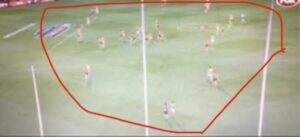
  • Studies usually analyse teams’ convex hull which gives the measure for the overall spread of the team in space but which ignores the contributions of the players that are within it

  • In this latest study they computed the convex hull of those internal players and then calculated the ratio of the area of the inner convex hull over the area of the outer convex hull which provides a single number that encapsulates the geometry of a team for a given point in time
  • The ratio of the areas of these 2 convex layers almost always dies out at .5 meaning there are almost no cases where the area of the inner layer exceeds 50% of the area of the outer layer in both attacking and defensive phases of play
  • You can determine how many opposition players a pass out-plays based on longitude coordinates
  • AFL uses talent tracker (?) at junior level to reveal spatial patterns in player development
  • Reduced player dispersion = shorter passing strategies
  • Greater player dispersion = longer passing strategies
  • On defense, teams devise formations to limit the oppositions space while maintaining cohesion
  • If a player goes outside of this then a teammate can be exposed to high demands to compensate for it
  • The convex hull is the area where all players fit into but the probability is that not all players in the hull are contributing to it so here they used an inner player convex hull and then looked at the ratio of the areas encapsulating (mostly) all spatial structure of a team to 1 interpretable number
  • This is to be used along with the external convex hull, not replace it, as they provide different data
  • Convex hull is great for overall team dispersion but doesn’t give you a lot on the intricate contributions of internal players to the team’s spatial structure where they’re pivotal in maintaining cohesion, controlling transition and sustaining tactical balance
  • Data consists of positional data including player and ball coordinates
  • Categories for collection x possession (deliberate control of ball for 3+secs), out of possession (opposition has deliberate control of the ball x 3+secs), undefined state (ball in play but lacking clear control), set pieces (10secs before/after a player returns the ball to play by taking a set piece such as a throw in, in/direct free kick, penalties and corners), dead ball (ball typically out of play)
  • Attacking success x play ball into forward 3rd + defensive success x ball stopped prior to the opposition forward 3rd
  • Divide the inner area by the outer area and results would range from 0 (if there were 0 – 1 player's contributing to the inner layer) to 1 (if the inner layer would fit perfectly into the outer layer which is practically impossible)
  • The convex hull is all players + the goal-keeper then the inner layer so a small area surrounded by big area
  • If the inner area is 10% of the outer layer then that’s a score of 0.1
  • Beyond splitting the data up according to different modes of play, they also wanted to separate it according to a ball-progressing measure such as when a team has possession, are they successfully progressing forward towards their goal and/or is the defensive team successful at preventing them from doing so
  • This is done via splitting the pitch into 3rds x defense, middle and forward 3rds
  • A successful ball-progression occurs when the ball is played from 1 area to another in a single possession
  • On defense, teams can invite them deep to counter with more space but it still stands for the most part
  • The study was able to compute the convex hull for both inner and outer layers and technically there could even be 3 layers but it won't be the case for the relatively small amount of players on 2 soccer teams but for AFL it definitely could be
  • A universal patter emerged that was regardless of whether you were in attack or defense, that both result in drastically different spatial structures – spread/compact - or even whether they were successful ball progression attempts or not, the ratios peak at .18 (inner is 18% of outer) and these distributions always die out at .5
  • There were barely any cases where the ratio was .5 or more
  • The typical number of players that created the inner layer was 3 - 5 players (4 mostly) and 5 – 7 for the outer layer (6 mostly)
  • Goal keepers are now often involved in transition offense but once they gain control in their forward half then they frequently remain near the opposition goal so that can skew things a touch but the ratio of where things die out is similar anyway
  • In the search for a possible 3rd layer, they typically found 0 – 2 players within the inner layer (core players)
  • The higher the layer ratio, the closer the players in the inner layer are to the outer layer
  • The area of the inner layer (convex hull of the central players) is always up to 50% of the outer layer
  • Layer ratio always dies out at .5 regardless of the phase of play, whether ball progression was successful or not or whether goal-keepers were taken into account or not
  • A previous study showed that the average distance between defensive and midfield lines was 7 - 13m v midfield/attacking lines 9 - 17m but can vary depending on team strategy as a high pressing approach reduces inter-line distances while deep defending can also compress those spaces
  • This study facilitates a rapid assessment of whether teams are occupying significant portions of the peripheral zone, thereby creating a narrow corridor between inner and outer layers
  • If this is the case then it may indicate a vulnerability in the team’s defensive positioning and potentially exposing them to exploitation by the opposition but if this is always true then could teams adapt to new forms of collecting defending and are such gaps necessarily an issue for attacking?
  • Further questions to address include how does 1 team's instantaneous layer ratio depend on the oppositions? Where on the pitch and in what situations do we typically see smaller layer ratios depending on opposition? How does the location of the inner convex hull relative to the outer convex hull affect team performance?

Monday, December 1, 2025

AFLW GRAND FINAL GAME ANALYSIS - NORTH MELBOURNE v BRISBANE PART 2


There's not too much left to say really but I did attend 5 or 6 North Melbourne AFLW training sessions so I do have a small database of the training activities they use so I might package it all up at some point but I have been using their warm up with my senior women's team and it works really well in focusing and training with intensity from the very 1st second of training.

There are 3 clips left from the Grand Final with each being posted individually below.

- Brisbane Transition Offense

- Brisbane Defenders

- Numbers

For full access to this game analysis, register for a level 1 membership from https://aussierulestraining.com/membership-account/membership-levels/.