
I have been following Alan Couzens for some time now and it has completely switched my process on aerobic development.
In my teens and early 20’s I used to be able to run but after 3 – 4 years off footy and just doing gym and jump/sprint work, getting heavier (I was 55kgs as an 18yr old!) and just flat out ignoring aerobic training, once I came back to footy I was in my early 30’s and never really gave it a great effort to developing it specifically.
Fast forward to my mid 40’s and still playing open age footy, to be able to have repeated impact on the ground I need to be able to cover it and repeat that throughout a game so I have been trying to improve it as much as I can for the last 3 years or so.
We’ve all had coaches set up running programs for us to do at footy training but they’re usually majorly sub-par and everyone is completely different in how their energy systems contribute to their overall output.
All that happens in these running sessions is that we express whatever “fitness” we have but we are never building it.
High intensity/fatigue-based running can provide sharp improvements in a relative quick amount of time but it’s not aerobic development, and by skipping that part, you’ve skewed even further to the fatigue running side of the continuum, making it even harder to become a true aerobic athlete and severely limiting your running ability.
There’s a lot to cover here as this is 30 pages of Twitter posts and articles from Alan so it might jump around a little bit but I’ll try make it as simple as possible but it will consist of 4 posts!
He has a community forum that I am a part of where he will personally answer questions and there are plenty of helpers in there as well.
LACTATE TESTING
It all starts with lactate testing which isn’t feasible for a lot of us as his recommended lactate testers (no affiliation though) are $300+ and apparently testing strips are pretty hard to come by.
A few years back I was part of a university study that tested my VO2Max and lactate so I have some very basic numbers – albeit pretty old one’s that will have changed for the better or for the bad in that time.
Even though it’s hard to get lactate tested, it’s still crucial to know the thought process behind it which will help going forward.
FIRST RISE IN LACTATE
If your 1st rise in lactate occurs at less than 60% of max pace/power then you’re aerobically deficient so most of your training should be focused on easy work. Max pace being the max level of pace/power achieved at the end of the lactate step test
LACTATE LEVELS
1mmol/l is the aim but initially you might only be able to get as low as 1.5 – 2 but that’s fine, just hang out at whatever your lowest point is and watch it drop over time as you develop more mitochondria in your slow twitch muscle fibers.
To get it down, walk further than normal and possibly up to 60mins or more.
Blood lactate follows blood glucose so decrease glucose spikes, only putting in what you’re taking out.
2mmol/l is a horrible place to hang out so keep most work under 1.5 with a little bit in the 3 – 4 range and avoid the grindy range
LACTATE DURING ACTIVITY
If you’re running a 10min mile pace (2.66m/s) and it feels easy or you have a goal to run a faster time but you’re already @ 2mmol/L then you’re base is weak and you need to slow down...My 2mmol/L that feels easy could be 3mmol/L for some and 5 – 6 for others but 10min miles @ 2mmol/L is a poor aerobic base irrespective of the max
LACTATE CLEARANCE
Training for lactate clearance and lactate production are 2 different things...To maximise clearance, get aerobically fit as the body loves to use lactate as fuel but in order to do so it needs mitochondria which uses lactate as a substrate
LACTATE AT IT’S LOWEST
Does not come sitting on the couch...Suring easy movement our slow fibers take up lactate to use as fuel, blood glucose decreases and fat oxidation increases and this is what bottoms out lactate...For this I start the day on my pedal trainer for 30 – 60mins on my sprint and aerobic running days
LACTATE AND FAT BURNING
As lactate goes up, fat oxidation comes down and vice versa...The % of fat oxidation will tend to fall as blood glucose goes up except for well-trained athletes with a very strong metabolic base (more on that later)…Your highest % of fat oxidation will occur at your lowest lactate number though it might not be the highest power at that number e.g. 1 athletes lactate didn’t start to rise until he went beyond 250w but fat oxidation peaked at 175w...Your maximal % of fat oxidation will almost certainly occur somewhere within zone 0 and zone 1
MY EXPERIENCE
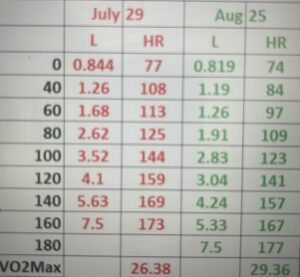
In the university study I took part in, I did multiple bike tests that spat out heart rate and corresponding lactate data at increasing levels of wattage and from that I was to at least see where my 1st rise in lactate was and what happened after that.
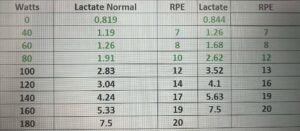
The study wasn’t set up for lactate testing, it was just a par of the data they took, not was the training program but I did see some progress from it in a lactate sense regardless.
TRAINING ZONES
Experienced runners will have heard, and trained by, zones so this is nothing new but once you have some personal lactate readings then you can go about determining your specific zones to really nail your programming. If you can't test lactate, and that's highly probable then there's other but les pinpoint ways to get your training zones.
ZONE 0
Is 15 beats or more below your 1st rise, but not spike, in lactate...Training in this zone is more beneficial for high fitness athletes v low/moderate fitness athletes but volume is volume and volume is the key that unlocks a lot of what I’ll post in this series.
Generally – active recovery, basic consistent movement throughout the day, can do as much of it as you like with zero implications
ZONE 1
Is the zone just before the 1st rise in lactate...Width of 10 – 15bpm…Will push the entire curve to the right and is the only zone that affects the entire curve...Coincides with max diastolic volume which is where the heart fills up to its maximum and is fully stretched on each heart beat that increases heart size and cardiac output/VO2Max
FAVORS FAT OXIDATION
It’s normal to struggle to run in zone 1...A general fit athlete with a 50 VO2Ma and an aerobic threshold of 60% VO2Max will perform zone 1 flat terrain at a pace at 2.22ms or a 7:31min km at the upper end so you have to psychologically deal with how slow it might have to be for you...Mechanically, for running take very small steps and keep your cadence up – very tiny strides – and your stride length will open up as your fitness grows over time
The general population average VO2Max is 35 – 40ml/kg/min with aerobic threshold of 50% of heart rate max...Zone 1 will be 40 – 50% of VO2Max (15 – 20ml/kg/km)...The typical economy when walking is 240ml/kg/km or less...15 – 20ml/kg/min means the person is moving at (240/15) = 16min/km = 2.3mph which is just a simple walk (more on this later)
Generally – 1.5mmol/L lactate or less, 60 – 72% of heart rate max, 55 – 60% of VO2Max, 9 – 12 RPE scale, unlimited time to fatigue, builds us up, easy warm up, easy conversation, easy effort, comfortable
MY EXPERIENCE
I couldn’t even slow jog and stay in zone 1 initially so I had to walk (treadmill, slight incline, slow pace) and jog/rest (jog then rest until heart rate gets back to 107bpm then jog again). I started jogging 37m then resting and slowly worked that up to 200m over 3 months or so for memory but I wasn’t staying fully in zone 1 at the top end but my heart rate was drastically lower during it though. I’ll probably never be able to run continuously for time and stay in zone 1 but there’s other ways to do it.
ZONE 2
Often, the relationship between zone 2 loading 3 months pre-test has a negative effect on aerobic fitness, the opposite of zone 1...When you rack up zone 2 load it’s because you’ve gone too long and it’s gotten too hard, and you’ve drifted from your optimal zone (1) where blood volume drops and the heart no longer fully stretches per heartbeat, type 1 muscle fibers are fatigued and you recruit less type 2, the more economical ones
Generally – 1.5 – 2.5mmol/L lactate, 73 – 82% HRM, 70 – 79% of VO2Max, 14 – 16 RPE, 2hrs time to fatigue, steady tempo, heavy breathing while talking, comfortable
MY EXPERIENCE
I’ve fallen victim to going too long and/or hard at times and there is a marketed difference between how you pull up from a 60min running session in zone 1 v zone 2.
I mentioned volume is the key to all of this and to be able to deliver high volume then you need to train daily and to train daily then you can’t be destroying yourself day after day. We’re looking for to bank day after day, week after week, month after month and hopefully year after year of consistent training so getting head around easy effort activity is a must.
My off-season started back on August 11, 2025 after footy finished and I have trained 159 out of 161 days in that time with an average of 162mins/day and how I do that will be detailed later.
ZONE 3
Generally - 2.5 – 4mmpol/L lactate, 83 – 87% HRM, 80 – 84VO2Max, 14 – 16 RPE, 1hr time to fatigue, moderate to hard tempo, talking is too much effort, somewhat uncomfortable
ZONE 4
Generally - 4 – 8mmol/L lactate, 88 – 92% HRM 85 – 89VO2Max, 16 – 18 RPE, 30minS time to fatigue, hard/threshold, talk in single words only, uncomfortable
ZONE 5
Generally - 8 – 12mmol/L lactate, 93+% HRM, 90 – 99 VO2MAX, 18 – 20 RPE, 15mins time to fatigue, very hard/at VO2Max, unable to talk, very uncomfortable
YOUR EXPERIENCE
Looking at those zones, where does footy training running programs fit in here do you reckon?


No comments:
Post a Comment