AUSSIE RULES TRAINING

AUSSIE RULES TRAINING & COACHING ARTICLES / PROGRAMS / DRILLS

TAKE YOUR FOOTY TO A LEVEL YOU NEVER KNEW YOU HAD

IT'S HERE!! aussierulestraining.com

Tuesday, February 24, 2026

2025 TEAM GRAPHICS

Last year I discovered a Twitter account called One Percenters which is actually a guy named Mateo Szlapek-Sewillo - a footy analyst who provides THE BEST season previews in all of AFL-media print, screen and audio.

I've linked to him before and with his permission I have started to put together some AI-generated graphics on each tea based of his preview of each team.

Today we'll cover Adelaide, Brisbane, Carlton and Collingwood.

ADELIADE CROWS


BRISBANE LIONS


CARLTON BLUES


COLLINGWOOD MAGPIES

Sunday, February 22, 2026

PRACTICE GAME ANALYSIS - WB/SYD + COLL/GWS


Week 1 of the practice games, or should I say match simulation, is over with and things get a little more real with official practice games this week before the real serious stuff.

I watched WB/Syd live and got sunburnt to a crisp but we (Swans) looked good and the Dogs were more than serviceable without a crop of their stars on the park.

The same holds for the Pies who were without most of their starting 22 but GWS had the week from hell in the lead up to the weekend and were also missing a few of their starters.

Some of the camera angles don't allow for a lot of the ball vision to be seen so I've got a lot of center bounce clearance clips.

Today we look at:

  • Bulldogs Team Defense
  • Sydney at Center Bounce Clearance
  • Collingwood at Center Bounce Clearance x 5
For full access to this game analysis, register for a level 1 membership from https://aussierulestraining.com/membership-account/membership-levels/.

Thursday, February 19, 2026

A.I IN AFL PART 3/3


Last week Sam Mitchell caused quite a stir when he admitted to using AI in his coaching process and although what was reported contained very limited detail of what he actually uses and what he uses it for, the uproar was ridiculous.

There is no doubt that AI will become a part of Aussie Rules in the near future as team's are always looking for ways to optimise and streamline their approaches and there's not an easier way to do that then through AI means.

On Twitter I came across this comment on the subject which of course sent me down the rabbit hole of this 341 page study titled "Artificial Intelligence-Based Decision-Making Support During Australian Football Matches" and here is part 3 of 3 of my numerous notes from it.

  • AI prediction of match outcomes study
  • Can machine learning models based on technical performance and not score margin, predict match outcome in real time?
  • All models performed well (73.5 – 75.8% prediction rate) v benchmark score-based model (77.4%) with accuracy being at its lowest at the start of the match (45.7 – 48.8%) and increasing to peak near the end of a match (87.2 – 92.7%)
  • A DSS is a computer system designed to support the decision making of the user
  • A handful of technical PI’s are able to predict match outcome from 78.9 – 95.1% but the models weren’t designed for in-game us, only pre/post-game
  • Wanted to test other metrics but scoring-based one’s and opted for meters gained, meters gained per kick, time in possession, inside 50’s, turnover’s, time in forward half, contested possession, effective disposal, groundball gets, marks on lead and rebound 50's
  • Defensive stats x 1v1 losses, rebound 50 differential, tackles, 1v1 wins, spoil differential
  • Transition stats x intercept from mark, defensive 50 rebound to boundary %, defensive 50 ball movement to wing %, defensive 50 ball movement to corridor %, turnover’s
  • Offensive stats x inside 50’s, repeat inside 50’s, uncontested marks, initial inside 50’s, leads targeted, scoring accuracy
  • Data should guide you with what to do, not just tell you what to do
  • Suggestions were made for it to dig deeper so they added an insights option which provided breakdowns of the subcategories of PI’s contributing to the broadly defined PI’s which formed the suggestion and the coaches liked it
  • What might be best is a combined approach where coaches provide a list of specific changes they might make during the game or have made before, coupled with their pre-conceived expectations of the way these would impact the values of their PI’s and instead of suggesting numerical PI targets, the AI could then suggest a small selection of these specific changes which would satisfy the teams needs according to the coach’s preconceived expectations and then the coach picks the most appropriate change in the moment
  • Long term, data can be collected on the actual impact of these changes and this database could be used to provide more objective actionable suggestions
  • Decision-making stages AI could support include opportunity trigger, understand the opposition, determine the need for action, explore options, evaluate the decision
  • Impact AI could have on decision-making constraints x manage information volume, reduce emotion, reduce time pressure, prompt early coach reaction, direct focus
  • An AI-based DSS should update regularly, be easy to navigate, use color, be customisable, be transparent in its confidence, provide the ability to manually dig deeper
  • Coaches respond to an opportunity trigger, they endeavour to understand the opportunity and then determine the need for action
  • If action is required, coaches explore options, take action, and then evaluate the decision
  • AI can handle far more information in time-constrained environments than humans and can pick up on patterns not recognised by the coach
  • Coaches should consider opportunities within current in-game decision-making/coaching practice’s where they would be willing to be supported by AI and communicate this with those responsible for building the DSS, use the discovery of context specific decision-making processes as an opportunity to reflect on your own practice by asking yourself: h
  • How am I becoming aware of an opportunity?
  • Am I truly considering the underlying cause of the opportunity before deciding?
  • Is taking action always necessary and how do I assess whether action is necessary?
  • Where am I sourcing my options from and am I leaning on the experience of others around me to support the exploration of options?
  • How/when do I take action and is my message getting across to the right people in an effective manner
  • How do I evaluate whether a decision was the right one?
  • The discovery of context specific decision-making constraints during matches serves as an opportunity to minimise some of these constraints through means other than AI so ask yourself:
  • Are there any ways that I can improve the way I communicate my thoughts to players/assistant coaches?
  • What impact does emotion have on my ability to make good decisions and how can I be more objective
  • What are the most important pieces that I want to be fed during games and have I communicated this effectively to my coaching team/support staff?
  • Work closely with analysts to find common ground on the types of DSS based solutions you think could be useful and provide feedback on any barriers you face when using the DSS
  • Give a DSS time to evolve, communicating with the developer about what would help build trust in the system
  • For analysts you are the conduit between the DSS and the coach and its effectiveness will depend on your communication of suggestions from the DSS to the coach, work closely with the person designing the DSS and provide suggestions for improvements + understand the underlying processes/technique involved so you can adequately explain suggestions
  • For researchers/practitioners/analysts aiming to design/develop/implement a DSS to gain an in-depth understanding of how coaches make decisions in their environment, you need to:
  • Build a DSS that fits their current processes
  • Consider ways to incorporate additional data types to improve on the current method
  • Work closely with coaches/analysts and consider the implementation of a DSS as a continuous process
  • Ensure the suggestions the DSS provides are sufficiently actionable for the coach
  • Be willing to compromise on perfect science to provide a DSS coaches will find most useful
  • Any new system will be competing for attention so incorporate desirable functions of older/pre-existing systems into the new DSS

Wednesday, February 18, 2026

BRISBANE v CARLTON PRACTICE GAME ANALYSIS

Interesting game for a practice hit out last night.

For me I wanted to look at Brisbane's ball movement which I covered in detail here in which I will be constantly referring to in any Lions videos this year.

My best mate is a Blues supporter so I'm somewhat interested in them as I have to watch them live a couple of times a year when he comes up but also a local boy from down my way and an ex-teammate's son Taylor Byrne was playing so I was very keen to see what he would do and he didn't disappoint - kicking 3/.1 all in the last quarter to get the Blues over the line. 

This will be broken up into a Brisbane part and then a Carlton part.

BRISBANE

After going through numerous Brisbane games late last year, and same as watching/analysing Sydney and Collingwood games previously, it's impossible not to watch them play and pick up on the trends I've identified in their respective products (Sydney, Collingwood).

In Brisbane's case it's short kick possession football, patience with the ball, hit up leads and getting length towards goal of which all of these are touched on in the video + the companion video I alluded to.

CARLTON

As mentioned in the video the Blues are a big work in progress as they turn their list and game style upside down and this video shows a clip of the "good/new" Carlton but then the "old/crap" Carlton rears its ugly head as well which will be their vibe this season I think but at least there's a conscious effort to change unlike previous years of going to the contest well over and over again.

For full access to this game analysis, register for a level 1 membership from https://aussierulestraining.com/membership-account/membership-levels/.

Tuesday, February 17, 2026

A.I IN AFL PART 2/3


Last week Sam Mitchell caused quite a stir when he admitted to using AI in his coaching process and although what was reported contained very limited detail of what he actually uses and what he uses it for, the uproar was ridiculous.

There is no doubt that AI will become a part of Aussie Rules in the near future as team's are always looking for ways to optimise and streamline their approaches and there's not an easier way to do that then through AI means.

On Twitter I came across this comment on the subject which of course sent me down the rabbit hole of this 341 page study titled "Artificial Intelligence-Based Decision-Making Support During Australian Football Matches" and here is part 2 of 3 of my numerous notes from it.

  • Information that needs to be collected from coaches before building a suitable DSS are what's your background/experience? How long were in each position? How did they lead to your current role? What different types of decisions do you make during games? Why do you see them as important/necessary? What factors impact those decisions? What information do you rely on to make game decisions? How does that information help you do that? Do you use either internal or external sources of information? Describe a specific decision you made in a game and the process behind it? How did you identify the problem? What did you do next? How did you evaluate the decision
  • Opportunity Trigger refers to data, coach observation, intuition and momentum
  • Momentum can be identified through objective (you can see it) and subjective means (a change in pivotal stats, quick shifts in scoring, field position etc)
  • Understand the Opposition refers to looking for context, experience, using data as evidence and involves searching for more detail/why is it happening to make an informed decision
  • Coaches will use data to reassure what they’re seeing is correct
  • Determine the Need for Action refers to the fact coaches can’t control some things and sometime doing nothing is the best method as players play well or play bad in any given game which is again out of the coaches control
  • After an uncontrollable factor causes a problem, it’s better to consider the players intention in the moment and keep going
  • A key aspect of a head coach’s decision making is to find the balance between when to and when not to change things up and where that balance lies may depend on the coaches philosophy/belief in the capacity of the players to solve a problem on their own even though a lot of coaches favour immediate performance benefits over valued learning outcomes for players during games
  • In the end, the determination for or against change either halt the decision-making process (no change) and reassess layer or change (proceed to the next stage)
  • Explore Options refers to sourcing options, action types, weighing up the value of action
  • Coaches want to hear the ideas of others in this phase of decision making
  • Coaches will rarely do things they haven’t at least talked about during preparation
  • When you solve 1 problem then another opens up – there’s a cost to every decision
  • When selecting an option that is good enough there is a tendency to go beyond picking the next best option and through explicit consideration/calculation or risk/reward, the exploration of options represents a coach’s best attempt at reasoning within their constraints
  • Take action refers to the head coach having final say + frequency/timing of decisions
  • The coach's role is to facilitate the decision-making process collaboratively and they then must filter all the information and then assume sole responsibility to make the call
  • Avoid sending messages out in the last 5mins of a quarter so you can properly deliver it at the break
  • Evaluate the decision refers to the fact that not every decision is right + consequences of getting decisions wrong + time to evaluate
  • You'll rarely win from making the right decision/s but you can definitely lose if you make the incorrect ones
  • You have to allow time for 1 change to work before making another
  • Coaches can make rapid, pre-emptive decisions to allow a more considered decision to come later which is 2 subsequent decision-making processes (1 rapid/1 extended) where the evaluation from rapid leads into extended
  • Barriers to A.I decision-making study
  • To minimise decision-making constraints, you could develop/implement a DSS system
  • Information that needs to be collected beforehand includes what barriers to effective decision-making do coaches face during games? What are the thoughts/perceptions of coaches towards A.I based DSS’s during games? What are the visual functional design elements which would enable coaches to utilise/interpret information provided by a DSS?
  • A hypothetical might be a scenario where we're down at half time, we don’t know what’s going wrong or what can fix to improve our chances of winning
  • At half time we use the DSS by adding in instance 1, import live data, observe interface and then read the suggestions
  • You'll also be able to navigate the simulator tab and play with a stats toggle to simulate what different changes in your stats will do to your predicted chance of winning
  • Barriers to decision-making include cognitive deficits via coaches emotion, delayed reactions/misdirected focus
  • Environmental deficits via time pressure, difficulty in communication, the physical environment (up in the coaches box v on the bench) and information volume
  • Cognitive barriers to decision-making constrain the decision-making process internally via coaches experience and cognitive limitations
  • When emotion develops into a barrier then you need to catch your breath and stop and look the wall/have a drink to shift your mind away from what you’re actually seeing
  • Coaches expressed they sometimes identified potential options but refrained from implementing them due to their concern that their communication of the message would be ineffective
  • Without a collaborative, calm environment, the ability to make decisions in a rationale/collaboratively way is hindered and there’s less psychological safety around incorrect decisions
  • Coach Thoughts/Perceptions on DSS included an un/willingness to adopt (replacement/hesitancy), expectations (ease of use/what coaches want), concern/criticism (oversimplicity/overreliance), the actual DSS role (when and how/who and why)

Sunday, February 15, 2026

A.I IN AFL PART 1/3


Last week Sam Mitchell caused quite a stir when he admitted to using AI in his coaching process and although what was reported contained very limited detail of what he actually uses and what he uses it for, the uproar was ridiculous.

There is no doubt that AI will become a part of Aussie Rules in the near future as team's are always looking for ways to optimise and streamline their approaches and there's not an easier way to do that then through AI means.

On Twitter I came across this comment on the subject which of course sent me down the rabbit hole of this 341 page study titled "Artificial Intelligence-Based Decision-Making Support During Australian Football Matches" and here are my numerous notes from it.

  • During games coaches face limitations to available information and cognitive capacity (calculating risk/reward)
  • A decision support system takes complex computational methods and empowers the user with them in an interactive/easy to use manner
  • Can pinpoint in-game performance indicators and their relationship to success in that specific game
  • Phase 1 x exploration of in-game decision-making of AFL coaches
  • Phase 2 x develop a decision-support systems (DSS) to leverage AI/Performance Indicator’s (PI's) predicated on the insights gained from phase 1 to support coach in-game decision making
  • Phase 3 x deployment/implementation of dss with AFL clubs to evaluate DSS impact
  • Decision making is intertwined within the coaching process in both participation/performance settings
  • Coaching is built on a cyclical relationship between information, knowledge, skills of the coach, athlete's capabilities, performance analysis, competition and preparation, all that require elements of decision making
  • The need to make complex decisions to fit the problem at hand may result in some parts of the coaching process receiving more attention than others
  • Coaches employ naturalistic decision making, consulting common sense models developed through experience with the premise of decision making being that decisions emerge from a subconscious process of scanning the environment, recognising a decision problem (a mental threshold is triggered) and consulting knowledge stored as mental models without explicit reasoning resulting coaches using mental simulation/consultation of previous matching decisions from decisions in time=pressured situations
  • All decision making requires ongoing situational assessment that triggered some form of action which suggests that there is more to coaching than experience/intuition and it relies on the idea that the formulation of decisions still rests heavily on the cognitive processes of coaches
  • Coaches should consider their decision-making environment
  • In complex situations, individuals trying to make rational decisions (based on reasoning) usually end up making satisfactory ones but not the optimal one because rationality is constantly bound to the interactions of cognitive/environmental constraints = suboptimal/inconsistent decisions with making the right decision being heavily dependent on the information available and how well a coach interprets it
  • Cognitive constraints (memory, heuristics, knowledge, problem solving ability) + environmental constraints (sport science, assistant coaches, performance analysis, athlete monitoring technology, available information) = rational decision making capabilities
  • Inconsistent decisions will be made based on instinct alone
  • Coaches need to consult with both cognitive/environmental constraints to make informed decisions
  • Machines can process larger/more complex loads of information than humans and more rapidly
  • Human data collection can be inconsistent from different interpretations
  • PI’s are quantitative measurements of action variables that aim to define different aspects of performance and they should form the basis of analysis
  • Research in AFL found that winning teams were different to losing teams with regards to 14 out of 16 analysed PI’s including greater values for kicks, handballs, marks, inside 50’s, un/contested possessions and tackles
  • In AFLW, PI's were disposal efficiency, kicks, marks and uncontested possession = winning
  • Coaches can use data to make decisions to maximise/minimise certain PI’s
  • Rather than using PI’s to compare un/successful performances, use PI’s to group players into positional roles
  • PI’s related to ball winning, ball use, hit outs, defense and negative performance can allow coaches to identify players of a desired positional role while supporting recruitment/selection decisions
  • Feedback can be categorised by valence (positive/negative), prescriptive (information on how to change performance)/descriptive (described performance) + content/audience
  • Post-game feedback retention from players is low possibly from being ineffectively delivered and it is more often descriptive v prescriptive which allows athletes to self-regulate their response to feedback in a way that is conducive to learning
  • Rather than trying to immediately correct performance, the coach is afforded time during the week to consider the best way to correct performance through further feedback/training design
  • Pre-competition feedback should be targeted towards decision-making by facilitating knowledge creation so they need to allow players to solve problems independently while guiding them in the right direction
  • Training is the time to manipulate the quantity of feedback to develop problem solving abilities with pre-post competition feedback focusing on providing players information they need to form their own decisions
  • AFL has a runner to deliver messages with 81.3% being prescriptive and 58.4% were controlling in nature where coaches pressured players to think/act in a certain way = a higher proportion of prescriptive feedback v other sports
  • Coaches send out 15 messages/quarter with the highest amount coming at times when the game is undecided and significantly lower in games when the game was "over"
  • Expert decision makers recognise cues/patterns quicker than novices but are still limited by the information processing capacity of humans and machine learning can combat these limitations by finding patterns that the coach doesn’t have time to and decreasing the need to analyse raw stats and have more time to apply expert judgement with a higher standard of information than previously
  • Decision trees classify outcomes by splitting the data on features that provide the most information about an outcome until splits can no longer be made such as meters gained relative to turnover’s forced score relative to time in possession relative to win/loss + meters gained relative to turnover’s force score relative to win + meters gained relative to turnover’s forced score relative to disposals to win/loss
  • Trees terminate the splitting process when a selected information threshold/tree length is reached
  • Of 97 PI’s available for analysis, decision tree model accuracies were as high as 88.9% for finding the most important PI’s to winning being meters gained, inside 50’s per shot on goal, turnover’s forced score and time in possession
  • Although accurate/easy to interpret, they can be too simple to provide great insight into performance
  • Via a generalised linear model, score margin was predicted on average within 7.4pts with the most important measures being inside 50’s per shot, inside 50’s and rebound 50’s
  • Converted to win/loss outcomes, generalized linear model sits at 95.1%
  • Technical PI’s can explain performance just as good as tactical PI’s but tactical provides a more unique insight into performance
  • Cognitive constraints (coach's perception, memory of events, philosophy, opinions) + environmental constraints (live match stats, athlete monitoring technology, information from assistant coaches) + suggestions from decision support system all go to the coach's mind = decision is made and communicate to players
  • To make a DSS these question’s needing to be answered include how do coaches make decisions in competition, what barriers to effective decision making do coaches face during games, what are the thoughts/perceptions of coaches towards the use of AI-based DSS’s during  games, what are the visual/functional design elements which would enable coaches to utilise/interpret information provided by a DSS, how efficacious are score agnostic models for the prediction of end-match outcomes in games, which variations and what type of model is the most useful for supporting coaching decisions during games, when implemented in the field what is the impact of an in-match DSS on coach decision making during games, how does the way a DSS is used change throughout an implementation, what are the elements of a DSS or its implementation process which contribute (positively/negatively) to the uptake of the system…
  • In-game decision making consists of 6 stages x opportunity trigger, understand the opportunity, determine the need for action, explore options, take action, evaluate
  • Bounded rationality, an extension of rational choice, describes the process that coaches employ to make decisions with the outcome of the decision dependent on the interaction between the available information, their own cognitive limitations/biases and the finite time in which they have to act and given the same decision making prob, it explains how different coaches can come to different right decisions
  • Coach decision making study - bounded rationality highlights the benefit in having access to the best possible information/environment with masterful mental capabilities (perception, knowledge, metacognition) when making decisions
  • A common framework for understanding the decision making of sport coaches is naturalistic decision making and it explains that in time-constrained decision making environments, expert coaches will scan for/attend to key attractors/recognisable patterns in a continuously unfolding environment, framing a decision problem if a mental threshold is reached
  • Key attractors immediately lead expert decision makers to a simply matched solution in most cases though they search for additional cues to diagnose the problem if an immediate solution is not recognised
  • In some cases, a stored solution may not match the present problem leading to mental simulations of potential modifications to solutions from previous experiences to evaluate their applicability to the present problem
  • Coaches have more time to make their decisions in v players/umpires and therefore can engage in more critical reasoning

Saturday, February 14, 2026

STATE OF ORIGIN GAME ANALYSIS

Footy is here and it's about time.

I think most of us weren't sure how this game was going to look and turn out to be but rest assured it was more than worth it, and something that can easily work in the long term.

On paper the Vics looked ridiculous and not that WA were any slouches themselves, but a midfield group of Bont, Butters, Diacos with a secondary unit of Serong, Merrett, McCluggage, Richards, Anderson and Rowell is stuff All-Australian teams are made of.

After a fast start for WA, they couldn't quite complete their numerous comebacks but the game was definitely competitive and how the AFL decide to rill with this going forward is anyone's guess.

When this was first announced might thought was to rotate teams as much as possible so that it's not always the Vics and then players like Bont/Daicos who would be in it every year start skipping years because the shine has worn off. If states plays every 3 - 4 years or so then that's 1, maybe 2 opportunities to represent your state so the hunger will be there every time it presents itself.

Unfortunately to make this a commercial success I suspect the AFL want it to be (and that's usually all they're interested in), they'll need the Vics in it 80% of the time.

From this game we look at:

  • Richards Wing Run
  • Buying Your Time for Your Midfielders to Reconnect
  • Jackson Midfield Run
  • Greene Exploiting the Stand Rule
  • Gawn Takes His Defender
  • WA Fat Side Line


Thursday, February 12, 2026

A NEW TRAINING TOOL OF MINE


When you're still (trying) playing open-age footy at 47yrs of age then you'll search high and wide for anything that a) makes it easier to do so, and, b) could still provide additional performance benefits.

I have followed David Weck for a while now and although a little eccentric, it's probably passion more than anything else.

He has a very specific twist on performance training, having previously invented the Bosu Ball, of which I have one at home from years ago.

His latest product is the Pulse Power Vest that I received earlier this week and took it for a test spin yesterday of which I detail in this Twitter thread.

It wasn't cheap to get all the way over here to Melbourne but for an old athlete like myself, its potential for performance gains or at least maintenance, seems very high. 

The way that it fits to you also means it's extremely versatile where you can take it with you where you want to (you pick it up in 1 hand pretty easily) and you can use it in pretty much any exercise you like, including skill activities.

Limitless potential!

Pumped for footy being back tomorrow night too by the way!!!!

Tuesday, February 10, 2026

PSYCHOLOGICAL PROFILES OF ELITE ATHLETES STUDY


These notes come from this study on elite Soccer players but the exact same information processing and decision making processes is required for footy.

  • Sport at any level requires a deep understanding of the game, rapid information processing and decision making, not just physical abilities
  • To close these gaps this study used elite soccer players and then focused on more psychological aspects of performance than other studies such as problem-solving, memory, executive functions and personality traits while evaluating via multiple means to get a comprehensive assessment
  • Elite athletes demonstrated heightened planning/memory capacity, enhanced executive functions - especially cognitive flexibility - elevated levels of conscientiousness, extraversion and openness to experience, coupled with reduced neuroticism and agreeableness
  • Non athletes report high elevated levels of neuroticism and agreeableness
  • Executive functions (high order top-down regulatory mechanisms controlling low level processes) are of great importance for success in ball sports as they make it possible to adapt and plan behaviour in a fast-changing environment
  • Design fluency performance correlates higher with national players then with Premier League players and those players are also described by coaches as the best readers in the game
  • Executive function and coach-rated game intelligence also correlates highly
  • The battery of tests they used were also able to predict assist/scoring behaviours + dribbling
  • Versus the control group, soccer players have better memory, problem-solving skills, are better at planning tasks, have higher levels of working memory, have superior efficiency in analysing situations/devising optimal strategies to achieve their goals in the same time frame, have the ability to plan several steps ahead in order to reach a goal quickly in a changing environment, reach high scores on temperamental scales such as persistence, harm avoidance and cooperation while also score higher on impulsive scales such as seeking sensation and positive urgency
  • Working memory is the single strongest correlator

Monday, February 9, 2026

FOOTY TRAINING NOTES FROM MY PHONE

Your best thoughts and ideas come from walking with zero agenda, effortless and automatic tasks like doing the dishes, mowing the lawns etc that we palm off a lot these days.

I walk the dog each day, sometimes twice a day and it provides some stillness to the brain that allows for thoughts to wonder in and out.

The secret is to provide time, quite time and time when you're not entertained by something else.

Often on my dog walks (around a footy oval 1 block from my house of course!) I'll think of something that's been floating around for a day or 2 and go into a bit deeper about it and then pop something in the phone about to for future reference and that's how this post came about.

A mixed bag today with a training activity, some short thought-pieces and a quick game analysis clip looking at:

- Triggers

- You Must Fail at Training

- Ego Play

- Brisbane Creating/Utilising the Outnumber Advantage

For full access to this coaching/training article, register for a level 1 membership from https://aussierulestraining.com/membership-account/membership-levels/

Sunday, February 8, 2026

VISION IN FEMALE ATHLETES

Last week I did a huge post on ACL injuries in female athletes and if you did read it, then I'm sure you would have not been aware of the latest how and why's of these occurrences.

All we hear on TV during these instances is commentator talk of "the mechanism of an ACL" but there's so much more leading up to that that I wish just 1 of them would get educated on all things ACL and then be able to talk viewers through it a lot better.

One of the main findings from my previous post was that if vision and this is ultra-important as what you see dictates what you can perceive and that dictates how you act.

The "mechanism" is simply the last part of the injury moment and the most obvious.

About a year ago I looked up the differences in vision between male and females after thinking why females drop so many marks and wondered if there was more to it and there is.

Differences in eyesight involves hormones, evolution and brain-wiring.

The visual centers in the brain work differently in men and women with men having a greater knack for fine detail and rapidly moving objects and women are better at discriminating colors.

The brain contains high concentrations of male sex hormone receptors (androgens) throughout the cerebral cortex, especially in the visual cortex which is responsible for processing images.

Androgens are responsible for controlling the development of neurons in the visual cortex during embryogeneis meaning males have 25% more of these neurons than females.

Males are then more able to resolve more rapidly changing images that are closer together then females, but when images were far apart there was no difference between genders and both struggled.

Males have better visual tracking from evolution of being hunter/gatherers which goes a long way to explaining the marking issue I initially had.

The 25% increase in neurons from earlier also allows males to see color more clearly, usually visualising bright red as that color has shorter wavelength.

Females can visualise grass as green where males sometimes see it as yellow!

For females to improve their ability to track moving objects, here some things you can do and all it takes is 5 - 10mins per session 3 times a week. 


SMOOTH PURSUIT TRACKING

This refers to tracking a ball moving in various patterns for a few minutes at a time such as watching tennis and hockey, where the ball rapidly moves across the field of view which helps your vision and brain keep up with fast motion.


VISUAL STIMULATION EXERCISES

These refer to videos designed in a natural setting by observing moving objects in the environment.


REGULAR EXPOSURE TO MOVEMENT

Spend time outdoors tracking moving objects like birds of kids playing 


LIMIT CLOSE UP FOCUS

This obvious refers to phone use and incorporate more distance viewing


MULTI OBJECT TRACKING COMPUTER ACTIVITY

Perform this on as bigger screen as you can

https://cognitivetrain.com/multiple-object-tracking-test/


TIM KUIJSTERS TWITTER THREAD

Any "free" training that provides huge benefits but at no energy/resource cost is an absolute gamechanger!

https://twitter.com/kuijsters_tim/status/1787796031301648582

Thursday, February 5, 2026

MY LATEST RESEARCH ON ACL INJURIES IN FEMALE ATHLETES


I thought I had done 1 of these somewhat recently until I checked back the other day and it was 2022!

There's still a lot of ACL's being done in both men's and women's footy - 19/800 men's + 23/550 women's in 2025 - which by those numbers isn't a great deal of difference really but the hysteria around female ACL's is sometime ridiculous.

No one wants anyone to do an ACL but it's a part of all sports for all genders.

Looking more closely at female ACL's in AFLW, it's a mixed bag from the somewhat limited data I could collect.

  • 23 ACL's injuries in 2025
  • 13 in games and 10 at training
  • 3 in marking contests
  • 2 from indirect contact
  • 3 from non-contact
  • 1 from direct contact
  • 3 from neutral actions
  • 3 from attacking actions
  • 2 from defensive actions

The notes below come from about 15 pages of info I've collected since 2022 with my go-to coach being Jason Avedesian who doesn't seem to be on socials anymore and now is part of the Cleveland Cavaliers in the NBA.

What I've been onboard with for a while and what gets a fair run in these notes is that the physical side of ACL injuries is not the greatest pre-cursor to ACL injuries although it's usually the result after the fact of these injuries, and more needs to be done around the brain, vision and neurocognitive aspects of performance to really get ton top of it

There's a lot here so put your reading glasses on!

CAUSES

  • Biomechanical x trunk flexion, lateral trunk flexion, hip flexion, hip adduction, knee abduction moment, knee flexion, knee internal/external rotation, ankle dorsi flexion, ground reaction forces, single leg landing/cutting maneuver, limb symmetry and variability
  • Neuromuscular x trunk strength, quad-to-hamstring strength ratio, hip extensors strength and hip abduction strength
  • Environmental x surface type, weather conditions, activity duration and sociocultural perception of training
  • Neurocognitive x reaction time, working memory, processing speed, visual-spatial attention, impulse control, self-monitoring and dual tasking
  • Prior Injury History x ACL, ankle sprain and sports related concussion
  • Additional Factors x warm up implementation/compliance, lower extremity balance/proprioception, fatigue, knee laxity/anatomy, shoe design, stress/anxiety
  • Divided attention can reduce knee flexion upon initial contact, increased vertical ground reaction forces and reduced stability during landing/cutting

MOMENT WHEN 

  • Within the 1st 40 - 60msecs of contact and way before any conscious processing can occur with the visible bad mechanics being from the athlete not having enough time/space
  • Reflex time + electro-magnetic delay occurs in 110msecs after contact which passes before substantial force can be produced from the surrounding muscles after loading the ACL
  • Athletes can perform any movement safely in controlled conditions but in competition they must process enormous amounts of environmental information and that changes every msec
  • Sensorimotor processes during this are anticipation, pattern recognition, visual attention, response to initiation/inhibition, memory retention, kinematic cueing, reaction time, processing speed, working memory, spatial orientation, visual fixation and trajectory estimation which also changes every msec so you need to train small-sided games, oculomotor training, strobe glasses, sensory boards and live agility training
  • Decreased visual-spatial attention/delayed processing speed and reaction time/decreased working memory leads to perception action mismatch/timing leas to delayed neuromuscular response and increased tissue load = increased risk for lower extremity injury so modify cognitive/oculomotor risk factors via sensory boards/stroboscopic eyewear/sports specific virtual reality + game representative agility training = decreased lower extremity injury risk
  • Anterior tibial translation is probably the primary biomechanical mechanism for ACL injury and maximum knee valgus likely occurs after the ACL tear so focus on quad strength
  • Low visual fusion range (the ability to merge images from each eye into a single image) was the strongest internal ACL risk factor meaning non-contact ACL’s are sensorimotor integration deficits
  • Upper body contact is highly influential to ACL biomechanics and athletes landing 30 – 40ms earlier on the contralateral limb after upper body contact is the initial time we think ACL injuries actually occur

GAME WHEN 

  • Primarily non-contact during single leg deceleration, 40 – 80msecs after contact, unanticipated conditions
  • In Rugby 68% come from indirect/non-contact, 72% during off-the-ball actions and 73% in the 1st 40mins of a game
  • Action ratios are side stepping x 38%, single leg landing x 31%, deceleration x 31%
  • Pressing, tackling, being tackled, regaining balance after kicking and landings are the most frequent patterns
  • Are more prevalent early in the game then late in the game
  • 44% x non-contact, 44% indirect contact, 12% direct contact
  • 47% pressing/tackling, 20% being tackled, 16% regaining balance after kicking, 7% landings, 10% other
  • Most frequent inter-segmental positioning at injury frame x ipsilateral trunk tilt (lateral flex) + contralateral rotation (rotation to the same side), abducted hip (same side), dynamic knee valgus (same side), foot planted and externally  rotated (same side)
  • Injury timing during matches – 15mins or less x 26%, 15 – 30mins x 19%, 30 – 45mins x 21%, 45 – 60mins x 13%, 60 – 75mins x 12% and 75 – 90mins x 9%
  • 33 – 66% of non-contact ACL’s occur during defensive situational patterns x defensive pressing, high horizontal speeds, rapid deceleration, single leg loading, 84% involve neurocognitive error, deceiving action within .240ms prior, high neurocognitive load, knee valgus, extension foot position = horizontal deceleration training
  • Non-contact more likely than indirect/direct contact
  • More common in defensive actions v attacking actions + more common in out of possession actions v in possession actions
  • Injury frequency while pressing/tackling is way higher than other actions
  • More common in single leg support moments than 2 leg
  • Often involves complex multiplanar interactions with a predominace of knee flexion + a consistent knee valgus pattern at the frame of injury

NON-CONTACT

  • Is a sensorimotor integration error where athletes are usually visually distracted while focusing on something that’s not directly in front of them and an error comes in judging when/how much muscular force is required to decelerate
  • 50% present with zero valgus but they aren’t caused by valgus and it isn’t a good predictor as it’s probs caused by the ACL tearing, not the other way around
  • Biomechanically, 1st look at the trunk/hip where excessive posterior/lateral shifts can heavily influence knee joint loading
  • ACL/valgus are both caused by a lack of foot locking tension/collapse resulting in disorganisation between shin/thigh so train foot locking tension under pressure to produce organised movement
  • Many non-contact ACL's might stem from an athlete not being able to properly initiate horizontal deceleration via visual stimulation overload (perception-action mismatch) and thus delayed limb stiffness and rapid ligament loading

TESTING

  • Bilateral drops/jumps are not associated with ACL's as they are only ever performed in 1 plane of movement and the bilateral nature also has much greater force that can override unilateral deficiencies and is also a more controlled movement
  • Any ACL screening test must include a neurocognitive/dual task component
  • Non-contact occurs because of time and space constraints so employ a greater exposure to match-day demands when performing reactive change of direction movements
  • Many occur when the athlete is performing a dual cognitive-motor task such as attending to an opposition while changing direction but most rehab exercises are single cognitive
  • Drop jump/hop/cutting tasks are the 3 main tests used in rehab so dual task them by also using memory recall during them such as color cards and they recall them in the order you showed them, hold up a picture and they have to recall something from it (object/color etc) or show a shapes slideshow and the athlete has to say what shape preceded the "go" slide

TRAINING

  • Extended leg/flat feet landings don’t disperse force over all the leg muscles/joints and are high risk with plantar flexion allowing the calves to lengthen and help attenuate landing forces
  • Have your athletes perform cuts under anticipated/unanticipated conditions, film it and look for biomechanical changes at the trunk/knee
  • Yes, loading that exceeds tissue tolerance will cause an ACL to tear but there’s so much emphasise on the physical that it’s time to look into sensory input
  • There’s a relationship between visuomotor reaction time and non-contact lower extremity injury
  • 2 - 3/week x 5 - 10mins do small-sided games/strobe glasses/sensory boards/virtual reality
  • For every 10ms decrease in reaction time, there's a 15% increased risk for injury independent of any biomechanical testing
  • Think about low arousal conditions = low risk v high arousal conditions = high risk
  • Traditional linear learning methods practicing to achieve ideal movement is the least effective treatment but manipulating task constraints enhances athlete robustness
  • Use both internal and external focus of attention for ACL risk reduction/rehab but get away from internal as quickly as you can and then the implicit/explicit instruction depends on how much and what type of information is provided as an external foci can be provided both implicit/explicitly 
  • Gastroc serves an antagonist for the ACL ligament and the soleus antagonist so train seated calf variations
  • Implicit motor learning/random practice/differential learning are concepts that should be integrated when practicing to obtain the most optimal results when learning/fine tuning skills
  • A tired neck decreases movement/vision accuracy/precision and the slower you can process what’s around you then the slower you’ll be to react – better vision = more time/space
  • ACL injured athletes have worse visual memory than those who aren't and that is correlated with greater time to stabilise = decreased proprioception
  • Low vision scores are associated with peak anterior shear forces, peak knee abduction moment/angles and peak valgus during ball handling tasks – all classic pre-cursers to ACL injuries
  • Improve the ACL 11/Prep to Play programs by adding in neurocognitive elements such as moving limbs unilaterally, tossing tennis balls against a wall, reacting to partner calls, showing math/pattern cards you look at and then have to repeat back from memory etc – anything to ramp up complexity but not intensity
  • When side stepping, keep low to the ground and use small steps
  • When decelerating, get your weight on your heels, use tiny steps and get low
  • When changing direction keep your feet under base of support, avoid trunk flexion/rotation away from the direction you’re trying to go and face your intended direction

Wednesday, February 4, 2026

OFFENSE CHECKLIST

The 4th last game moment in the game action loop is offense and again there is overlap with previous game moments as they continually feed into each other.

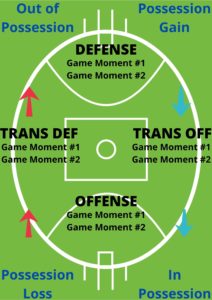
The full loop will now look like this:

Once you have identified the common themes among all 4 game moments, then that should be the foundation that you build your game model around as they are game aspects that are always at play.

The offense moment starts once we enter the launch zone or closer, or once you can get some overlap and put some speed on the ball such as Brisbane overcommitting on this Gulden mark:


WE HAVE POSSESSION IN THE MID 50

Scenario...

For full access to this coaching article, register for a level 1 membership from https://aussierulestraining.com/membership-account/membership-levels/.

Tuesday, February 3, 2026

DEFENSE CHECKLIST

If we follow the basic loop then after transition defense comes defense which these days is a full team affair, not just your back 6 defenders, and there is fair bit of overlap with the previous 2 game moments we've covered. The defense game moment starts once the opposition can work the ball into the launch zone area or closer, but it can also be further from goal depending on the pace of ball movement such as once Hipwood marks here -


WE DON'T HAVE POSSESSION IN OUR DEFENSIVE 50

Scenario...

For full access to this coaching article, register for a level 1 membership from https://aussierulestraining.com/membership-account/membership-levels/.

Monday, February 2, 2026

TRANSITION OFFENSE CHECKLIST

Today we look at transition offense which is when we regain possession and have control of the ball - such as the Lizard taking this intercept mark.


WE REGAIN POSSESSION IN OUR DEFENSIVE 50

Scenario...

For full access to this coaching article, register for a level 1 membership from https://aussierulestraining.com/membership-account/membership-levels/.

Sunday, February 1, 2026

TRANSITION DEFENSE CHECKLIST

This week I'll post some checklist templates you can use to ensure you're covering everything you need while training so your 100% ready for round 1 in around 10 weeks time.

You can add/subtract to this template but just ensure that everyone has a role at all times, it is clear what it is, and that they are performing those roles when they should be.

Also note that A/D123 can be players of any position on the ground and that these roles depend on the ball location so it's essentially the 3 closest players to the ball at any given time.

There are 4 game moments that I'll cover this week and each will be broken into 6 micro-moments.

What strategies/tactics you use around the micro moment is entirely up to you.

Today we'll start with transition defense which is the point in the game where we have lost possession and the opposition are now trying to work the ball forward to create scoring opportunities - or once Gardner takes this intercept mark.


WE LOSE POSSESSION IN OUR DEFENSIVE 50

Scenario...

For full access to this coaching article, register for a level 1 membership from https://aussierulestraining.com/membership-account/membership-levels/.