AUSSIE RULES TRAINING

AUSSIE RULES TRAINING & COACHING ARTICLES / PROGRAMS / DRILLS

TAKE YOUR FOOTY TO A LEVEL YOU NEVER KNEW YOU HAD

IT'S HERE!! aussierulestraining.com

Thursday, January 8, 2026

OUTSIDER COACH #3 - STEVE MAGNESS

Steve Magness is a performance coach, author and elite athlete with a very interesting past in elite sport that he has been very open about and is how I think I came to read of him initially.

He posts an excellent mix of training and preparation content with a different twist then most other coaches', but it can assist you greatly in becoming an extremely well-rounded coach - which you need to be - and something I am still working towards.

TENNIS GRUNTING

It’s not to hit the ball harder but to fool the opposition as they use the sound of the ball to predict how far the ball will travel and a loud grunt makes them think it will travel further

GOAL SETTING

Process has the greatest effect on performance...Performance goals have at worse, a moderate effect on performance results...Outcome goals have a negatable effect on performance outcomes

PARENTS

At games do not provide technical/tactical advice, only comment on effort/attitude and not performance, respect the sports etiquette and match non-verbal behaviours with supportive comments

BOYS v GIRLS

In running events there’s a consistent small gap from 7 – 12yrs of 4% or less but at 13yrs that gap jumps to 6% and keeps widening until 18yrs where it can reach 12%

LOSING STREAKS

Winning changes your biology giving you an unfair edge...Winners become more aggressive and losers become more timid and then winers keep winning and the losers keep losing...Winners get a surge in Testosterone (linked to aggression/risk taking) while losers testosterone plummets and cortisol increases, priming you for future encounters...It’s not just hormones, it’s also the brain where the activation of an area called the dorsomedial prefrontal cortex that transforms you into a winner through not just aggression, but also grit/perseverance...The DMPFC stores memories of past wins/losses and manipulating this memory can change your place in the dominance hierarchy even after the manipulation stops...Winning rewires the brain for future success...Win and you get a testosterone boost which increases your chances of winning next time...Even perceived wins can give you the testosterone boost showing it’s the belief that we won that influences our biology...Competition is about status and winners are more likely to rate themselves as desirable mates which highlights how winning can influence our social standing and even our romantic prospects...Dual hormone hypothesis suggests that high testosterone needs low cortisol to have the desired effect so if stress is too high then a testosterone boost won’t translate to increased performance...If stuck in a losing streak, oxytocins after losing works against stress hormones, soothing distress and activating our calm/connect system and allows for confidence to emerge...In athletes, higher oxytocins levels were related to self-confidence/lower anxiety...Having oxytocins before being ostracised during a game increases your desire to play again...How we handle winning/losing is connected where if we tantrum/default to avoidance after losing then we’ll settle into a protective state where we avoid challenging competition after a win...If we are balanced in losing then we’ll be balanced in winning

VIDEO GAMES

Is the 1 place where adults can’t interfere/control/critique...It's the 1 place kids can find autonomy/connection...That used to be sports until adults ruined it...Outside play has gone from 80% to 27% over the last 2 – 3 generations...An increase in safetyism and total control has killed unstructured play...We’ve replaced pick-up games with leagues, park footy with Auskick/junior footy all driven by adults, ego’s and money...Schools continually limit anything deemed unproductive such as recess, PE and music...A primary cause of the rise of mental disorders in youth is a decline in the opportunities for them to play, roam and engage in activities not run by adults...Play frees us up, helps us to learn who we are in an environment where we can fail/screw up...Helps us to develop intrinsically driven interests, learn about rules/problem solving, regulate emotions, navigate relationships/make friends and experience joy...Play is something done for its own sake, its involuntary/pleasurable, offers a sense of engagement and takes you out of time with the act being more important than the outcome...Even adults need unstructured play...We’ve shifted from playing sports to watching them

FLOW

Practice, practice and practice then forget all that and just wail...Jazz musicians/freestyle rappers train their brains to quiet the inner critic and turn up self-expression when they perform...When improving the dorsolateral prefrontal cortex, the inner critic that evaluates/monitors/2nd guesses, goes quite while the med prefrontal cortex (creativity/self-expression) lights up...When most of us try to improvise the brain does the opposite with the inner critic dominating and we overthink/hesitate/freeze and thinking gets in the way of doing...Experts have trained enough to move from reactive to reflexive...They’re not improvising from nothing as they’re drilled in scales, rhythms and progressions where practice loads the system and letting go unlocks it...This is why false bravado backfires as you can’t just believe your way into flow if the foundation isn’t there and the brain knows...Confidence is about having enough evidence in your body/mind that you can release control

EGO

Quitting isn’t always laziness/weakness – it’s a sophisticated form of protection…If we don’t try then our ego is still intact when we fail…It feels safer to say I didn’t try or they got lucky then to discover our best wasn’t enough…It protects our ego from coming face to face with our own inferiority…runners admitted looking for a hole step in to get injured for an out without damaging their identity as a runner…This freak out/urge usually happens when uncertainty is at its peak – when effort is high but the outcome is still unknown…Uncertainty leads to caution and defaults to protection rather than risk and running through cost-benefit scenarios…The 1st step to overcoming this is realising that the urge isn’t a sign of weakness but your brain trying to protect you…Give yourself permission to see what’s possible and potentially fall short, shifting away from wining/losing to exploring your limits…The protective urge is a malleable calculation your brain runs based on past evidence and to change it you must expose yourself to small manageable risks where the outcome is uncertain and by surviving these micro-failures without your ego crumbling, you teach your brain that the threat isn’t actually fatal and you slowly recalibrate your internal governor to value the effort over the protection of the self…You decide what matters more – maintaining the illusion of perfection or discovering your actual potential

ENDURANCE ATHLETES

Train in all zones…1 specific athlete recorded 52% of their training time at 6:10min/km pace or slower (2.7 meters per seconds)…28% at 530 – 610mins (3.03ms)…11% at 450 – 530mions (3.45ms)…8% at 425 – 450mins (3.77ms)…1% at 425 – 400mions (4.17ms)….1% at faster than 4 pace….2% hills...I suspect you're doing the opposite

EASY AEROBIC FITNESS

Lots of easy runs…Short/fast but controlled x 1/week (8 x 1min on/off or 12 x 30secs on/60secs off at 5k pace to 1.6km pace…Long/tempo x 1/week (4 x 5mins, 2 x 10mins, 6 x 3mins at half marathon to 10k pace)

Tuesday, January 6, 2026

OUTSIDER COACH #2 - BENE SCHNEIDERBAUER

Today we look at notes from German coach Bene Schneiderbauer so the content will be soccer-based but again it can easily be transferred to Aussie Rules Football.

He also has a newsletter you can sign up for at https://verticalpossession.com/.

TIME AND SPACE

The ball carrier needs to find the free player and then know when to pass them the ball...The receiver needs to know where the open space is and then know when to move into it to receive...You have to be in the right space at the right time, not too early and not too late...Sometimes you need to wait to see what space is being vacated by teammates/opposition so don’t move for no reason or you’ll just be out of position even more...Without the ball you have to run but with it you can walk/run much less...Let the ball run, not you...When the opposition starts to press that’s your trigger to look to move again, and into the spaces they vacate while pressing

BUILDING TEAMS

When things go sideways, stick with your formation and find solutions within your system, don’t change it...Instead of changing training structure every session, compress everything the game demands into 1 structure and repeat it every training session...Pick core games that cover every situation and repeat them until mastered...Everything you want to teach is inside the game but can you poke the game in a way to improve your players...Better teams focus on fewer things while focusing on bigger things

POSITIONISM v RELATIONISM

Positionism refers to the intention of players without the ball coming 1st (position)...Relationism refers to the intention of the player with ball coming 1st (and affords us better positions)...Does the position define the action or does the action define the position? It’s both...The individual action is not the starting point, the context is...Each individual's intention starts with the team intention = team-intentioned football...How we want to play as a team defines the individual action of the player with the ball (relationism) and without the ball (positionism)

PLAYER DEVELOPMENT

Is simply adapting to new football overload...When they are overloaded you can help them push through the challenge and they might never get there, or you can reduce the overload and make it a bit easier for them...Have small but consistent wins and someday they’ll explode with exponential growth

KNOWLEDGE

Drives player development, not repetition...Every repetition needs a feedback loop that generates football specific knowledge (implicit/explicit) and coaches should provide frameworks so players can reflect and organise knowledge on a solid foundation, not on subjective experience

TRAINING INTENSITY

Small spaces creates a high density of actions/minute so it looks intense which is fine but it often won’t lead to better players as it doesn’t allow the player to improve their actions as they have no time to think and just do the 1st thing that comes to mind, which is their usually their sub-par default action...They get conditioned to play fast but not better football which is actually a game of time and space...True intensity comes through quality...Improving the action improves the intensity of the game...When you improve communication you need less information to understand each other = less information to process = faster decisions = need less time/space to play = more intensity...Improved player positioning = can beat opposition with fewer touches = need less time/space to play...Make their game a little bit faster every time leading to better/faster football forcing them to get faster again in a positive loop to get better and better

UNPRESSABLE POSSESSION FOOTBALL

You’ve got 2 common options for development being individualise via breaking the game into tiny pieces and then reconstructing it back together v letting them play so they can naturally get creative and both are valid…A 3rd way is UPF where you attack in a manner where the opposition can’t get close enough to really press you defensively, or in our case, delay you for more than 1 – 2secs or intercept our marking attempts…By playing better team football, players have to adapt and that forces them to get better…It allows your team to not rely on being faster/stronger yet allows you to compete against bigger/stronger opposition…Using narrow training areas means you can’t rely on physicality/speed…Hide your intentions with feints to get the opposition 1 way when you fully intend on going the other…Think ahead to know what to do before you receive…Control the ball well in tight spaces…Players will learn all of these game moments as a byproduct of your practice and without having to teach each component in isolation…Perfection is achieved, not when there is nothing left to add, but when there is nothing left to take away

Sunday, January 4, 2026

OUTSIDER COACH #1 - DAVID GARCIA

I've got pages and pages of stuff compiled from all sorts of places with a lot of that coming from coaches that I follow on social media (Twitter's my preference).

Aussie Rules has always taken from other sports so to fully understand coaching tactically and socially, coaches from other sports have plenty to offer for local coaches like us.

Adding to that there aren't a lot of footy coach generous with their ideas and turning that into content that's not part of a $400 package that not everyone can afford and often, isn't real ground breaking itself.

David Garcia is a UEFA Licensed Coach and Coach Educator so is obviously soccer-based with his content but there is plenty of it that transfers to our own game.

The notes below are taken from numerous articles and posts from David and he's definitely worth a follow and a deep dive into his content, as will the other coaches I feature in this series over the coming week or 2.

There's even some training activities and a step-by-step process of how he saw and taught them at the bottom that WILL definitely help you when we go back to training in the next few weeks.

I've underlined what I think are the best points.

POSITIONAL PLAY

When initially teaching positional play, you need to meet coaches and players where they are...You need to build self-regulating players that can think for themselves, don’t give them the answers but guide them towards them and don’t instruct...Teach position based on all other game variables (opponent, teammates, your/ball location goals etc) which can be predetermined as its dependent on what’s happening on the ground...The player is in control of their position and coaches must observe their natural inclinations...Positioning cannot be predetermined/imposed because it depends on the game...Alter your methods to take those 2 things into account...Over time develop a way of working that is not positional play but instead observing/guiding players’ natural tendencies, preferably amplifying their most effective natural positioning tendencies, and when that doesn’t work, adapt their ineffective natural positioning tendencies

INDIVIUAL DEVELOPMENT

Games boil down to small sided versions of the game, namely micro 2v2’s...Coaches need to recreate these moments with players...The best way to succeed in 2v2’s is to create indecision for the defender that the offense can exploit that can give them more space/time...At an individual level, players must develop game understanding in order to create indecision which comes from consistent exposure to game-like situations...The coach can speed this along by directing attention towards important factors...The starting point is understanding you have a direct player (a pair) and you want to separate a pair to create an outnumber, the beginning of indecision

DRIBBLING (HOLDING THE BALL IN OUR CASE EITHER STATIONARY OR ON THE MOVE)

Is about leaving multiple escapes open for as long as possible, creating massive indecision for the defender and when the defender does decide, you go the other way

TEMPO

Must fluctuate in accordance with the creation/exploitation of spaces...Fast = Exploit...Slow Down = Create Conditions

BUILD UPS

You build up from the defensive half where you’ll usually have a number advantage but that only holds if you use the correct angles and distances...On the other hand the lesser players you need to build up with then the more you can have to attack with...A well organised attack leads to tactical advantages when you are closer to goal...It’s easier to score when receiving facing goals then when you receive with your back to goals (set shot v general play) but prior to that you must play through the opposing lines...The first line of pressure will usually have fewer numbers...Positional play uses game references to positionally create advantages...Decisions are entirely based on references (ball/space/oppo/teammates) so they must be present in training...Playing good football is based on the oppo’s movement and then you make a decision...If you can draw 2 players to you as the ball carrier, then you must have a close teammate who is now open and the ball has to get to them anyway-how...The start of a successful build up is this 1st step – invite the pressure – and a high press is an ally, not an enemy and you want them to jump out of position so your teammates can act on their disorganisation...You pass so they’ll jump and when they jump, then space is created behind them

EXECUTE 2v1's

Ball carrier engages the next defender...Off-ball players separate to provide passing options behind the direct defender who’s engaged on the ball carrier...Pace of pass needs to be appropriate to let the ball run and continue forward progress

POSITIONAL PLAY

Football is movement so to manipulate space/time we must be able to describe motion via position to moment to direction to speed...Better position = better moment = better direction = better speed...Young players lack better positioning and that affects the quality of everything else

LINE/CONE DRILLS

Players lose the ability to think/create

GOLD CHOICES

Easy choices are for average player's but the best can see/execute the gold choices...Gold choices break the game open...A forward pass that advances the ball past the line that is pressing the gold standard...These players invite teammates to make runs forward and forces the opposition to leave gaps...Needs to be coupled with positional play as you can’t pass to no one and can ten ball carrier and teammates both choose the gold standard at the same time...Can you create an overload and then utilise it

BUILD UPS

You’ll most likely have an outnumber advantage in your defensive half but you also need to get the correct distances and angles to be able to utilise it and then the less of these players you use the better as they can progress up field and continue to give you the potential outnumber advantage...Address the objective at each line via slices of the game such as the 1st def line in a kick out zone so say 5v3 then you can bring more players into play as it builds...All decisions are made based on game references x ball, space, oppo, teammates...Positional play is in the smallest details of re/positioning...Use the opponent’s movement to help make your decision as they’ll always be giving something but you have to find it...Draw the oppo so they create space by vacating it

SESSION DESIGN

ID a Game Situation...Determine Team Intention...Define Player Actions...Select Constraints...Design Training Activity...Reflect/Adapt

LANGUAGE

Establish a common agreement of fundamental football language in your environment...Most debates come from differing definitions...Imprecise language can hinder the observation/analysis of player performance...Develop a richer vocab for describing football actions, describing in terms of action x position, moment, direction, speed such as try to provide a passing option when as deep as possible in the direction of the opposing goal while still being in line with your teammate...Use intentions as a framework for shaping player behavior (game model)...Is your language leading a player towards a specific how (1 way to behave) or what (many ways to behave) such as when you're on the ball, attract as many direct opposition player as you can before you release the ball...Labels in a game/training activity can influence player behaviour such as calling a goal a "passing goal" that can encourage players to focus on accurate passing over shooting...Consider how words can be interpreted if taken literally such as heels on the touchline v separate from your mark as much as you need to be able to receive the ball with more space...Adopt new terminology as new ideas emerge

GUIDED DISCOVERY

ID a game scenario your team struggles with...Design a training activity that replicates it...Observe closely to their behaviour/interactions...Ask questions to guide their understanding...Help players connect their actions to the desired outcome

ANCHORING

A crucial moment has just happened in the game so how you as coach ensures this fleeting moment translates into a lasting lesson...Is designed to enhance player recall of specific game moments by intentionally marking them for later reflection...ID a key moment, anchor the moment (I want you to remember that), later reflection...By highlighting it you’ve told them that it is important so they must pay attention

COACHES v PLAYERS

Coaches x design training activities that replicate games, emphasise spatial awareness/understanding that player positioning impacts the team and game, instill guiding principles to promote coordinated action/self-regulation allowing for agency within a cohesive framework…Players x developing an intuitive understanding of how to create/exploit space, make decisions based on the context of the game and not just individual skill, recognise that their actions impact their team’s ability to achieve game objectives

RELATIONISM

A self-regulating player is someone who can think for themselves and who can solve game problems through their communication with the game environment, their decision making and how they interact with the game...To develop them, guide, don’t instruct...Meet them where they are via observing their natural inclinations...Relationism is a desire for self-regulating players...Self-regulated players can take their game insight to any club/team and adapt...Relationism is the desire to see self-regulated players...What Is to Reality + What Should Be to Ideal + How Do We Move Reality to Ideal to Methods

SELF AWARE COACH

Means having an honest understanding of your own behaviours, beliefs, biases and how they influence your interactions with players...ID/manage biases + understand the impact of your communication + create a positive/supportive environment + develop a growth mindset...Film yourself coaching, solicit feedback, journaling, mindfulness practices

CREATIVITY

Passion is a great force which unleashes creativity...There is no innovation/creativity without failure...Without change there is no innovation/creativity/incentive for improvement...There is no fountain of youth, it is your mind/talents/creativity you bring to your life and lives of people you love...Creativity is youth...Create unpredictable situations in training to allow for self-discovery/problem solving

MAKE LEARNING STICK

Players stop listening when you start repeating yourself so how can you ensure learning without saying a word...You give cues at training/during games but they don’t but experience needs to come before reflection so if they haven’t felt the mistake before, if they haven’t succumb to game-pressure then the instruction has nowhere to land...They aren’t defying you, they just haven’t had the moment that makes your insight theirs and you’re giving the reference before the experience...Create the experience 1st and let the prob emerge naturally then give it language that helps it stick...You want your feedback to receive facing forward then use a tight rondo/small sided game with pressure from behind and the reward is a clean forward exit and after the pattern emerges ask did you feel the different when you opened up instead of receiving flat?...To get your midfielders to scan before receiving set up a directional game where turning into pressure causes an instant to then ask what didn't you see and why did that moment break down?...You don’t need better speeches, you need better environments...When players feel it, they’re ready to hear it and then they’re also ready to own it

POSITIONING

A correct position doesn’t exist because it will always be in relation to a specific game situation and they’re ever-changing…Relational = the way in which 2 or more concepts are connected such as teammates, opposition, ball and goals…In any given situation on the ball you have connections with the opposition, your teammates and the (line to) goal…Players move themselves in relation to where the opposition is, where they can receive and then pass onto another teammate with the result being constant positional play which is highly relational…Positional play isn’t just about static positions but the constant adjustment of positions…All these relations is the information that players should un/consciously take into consideration and the only way for them to be able to do this is by training with all these elements in place…Training unopposed gets rid of all the game connections which is the information players use to reposition themselves

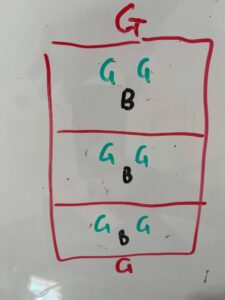
3 x 2v1 TRAINING ACTIVITY

Defending team defends for 90secs...How does the 2v1 get the defender out of position to transition the ball?...How does the 2nd 2v1 position to receive and transition?...Do they position to receive and go forward?...Can they draw the defender and then pass?...Do they pass before committing the defender?...Can the defender defend both offensive players at once?
PLAYER DEVELOPMENT TRAINING ACTIVITY

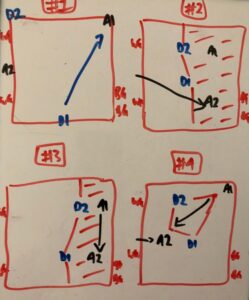
The training activity was a 2v2 to recreate a build up moment with each player having a starting position and starts with D1 kicking to A1...15x20m...The training activity was designed for the attacking players to have multiple options on the ball that would facilitate their success (#1)...What was happening though was that A2 would drop very deep to support A1 (#2)...They would receive and both A1/2 were easily defended and even pushed away from their goals (#3)...After a while an A1 said to their A2 "don’t move from the gap until you have to" which was the space between the D1/2 players which would naturally occur because D1 would press A1 (#4)...A2 would stay in that gap, A1 would split D1/2 and pass to an open A2 who can then receive, turn and score, which they did 3 times in a row before the D1/2 adjusted how they were defending...A1’s instruction provided direction of where to position, the moment they must reposition themselves and also shows that position isn’t static...This all comes about from the peer framework x personalise to players’ needs, engaging to keep them wanting more, emotional so they learn to feel the game and reflective so each time they walk away w/ insight...When you deliver training environments that check every box in the peer framework, then players will learn through experiences...The defensive team are trying to trap them on other side so they can score while the offense is trying to exploit the opposite side so if they turn the ball over they can recover before a shot on goal
BUILD UP TRAINING ACTIVITY

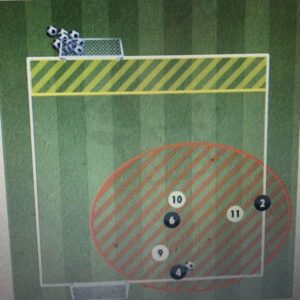
The game of football is all about the space you take up in relation to the ball, why you take it up and you can’t forget this when planning practice...Game starts with 10 passing to 4 then all in...Black/attackers aim to dribble into end zone or score in goal...If white regain possession then they score in their goal at the bottom...15x24m
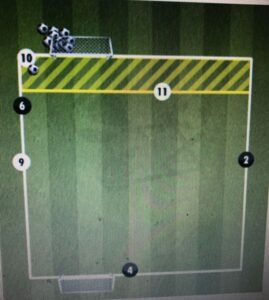
Initially the attacking team got stuck along the sideline or in the corner with the defending team doing a good job of closing down passing options while pressing the ball carrier...both attacking supporting players would congest the ball carrier making it impossible to play past the press
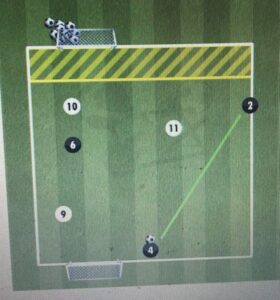
The first correction was #2 who’d just gravitate towards the ball carrier but they should be getting to space to drag a defender out and/or be able to receive...By 2 staying where they are then the def/11 has to decide who to try and cover
Even after this is it was still a struggle for the attacking team and it was due to when 4 decided to pass...Too early would make it easy for 11 to intercept or get to 2 as they received/pressing trap
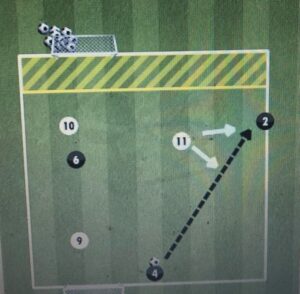
Took 4 aside and said forget the outcome, look where their 11 is and dribble towards them and when they step, you release to 2 – directing their attention to a potential solution but they still needed to read, recognise and execute...The very next rep, 4 dribbled towards 11, fast enough to avoid pressure from 9 but in control enough to release when necessary...11 instantly froze – indecision – step or stay
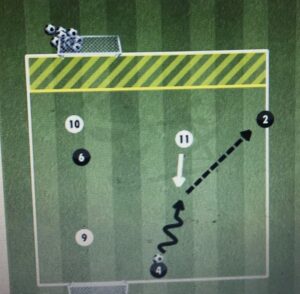
4 released when 2 was entirely free from 11 because they had engaged them...4 dribbles into end zone and scores repeatedly...Then the defending team had to adapt and they did, and then cat and mouse ensued...This is how players become intelligent thinkers – read/recognise/execute – but they’ll get stuck so then your job as coach is to provide as much direction as necessary (not all!)...This is only possible when training activities are representative of the game

Monday, December 29, 2025

4 LEVELS OF BALL MOVEMENT TRAINING ACTIVITY

Often coaches will try and develop a lot of different training activities for variety sakes but with change often comes a loss of focus on the game day principles you're trying to instill in your players.

This also increases prep time and extra training time for players to adjust to the new activity before they can really dig deep into solving the problem it delivers and then learning is incomplete and those gaps show up on gameday.

Coaching can be a bloody hard gig, especially footy with 20 - 30 players under your guidance at 1 time, so if you can make the lay-out of training as easy as possible, then you have more time and cognitive resources in actual coaching.

Below are 4 levels of a training activity for ball movement with similar set ups but the principles of your ball movement remain true in all of them.

Study the differences between the levels, in regards to the level of ball movement from easy to hard, low complex decision making to high, as well as time and space provided by the defense.

As always keep the focus the focus, in which case is ball movement, so don't go talking about the defenders and shifting the focus away from offense and ball movement.

LEVEL 1...

For full access to this training activity sequence, register for a level 3 membership from https://aussierulestraining.com/membership-account/membership-levels/.

Sunday, December 21, 2025

WOMEN'S FOOTBALL TRAINING 2026

I'm continuing in my role as Senior Women's Head Coach for season 2026 and we had 7 sessions before breaking for Christmas with 1 focus and that being ball movement.

In our first season out of a 4-year recess, and my first year at the club, we had a lot of players new to football or coming back from lay-offs so we weren't able to put a lot in place as a team offensively and really focused on contested footy which served us well as it played to the strengths and capabilities of the team.

This off-season we have been on a recruitment binge and have already brought in 8 new players and another 8 or so that we're hopeful of getting the club for next season - with most of them having division 1 experience.

This means out overall skill level is well above last year so we're going to work on utilising that on offense with a clear plan of what to do when we have possession.

The tactics aren't mind blowing but the aim is to make the positioning and intent once we get the ball automatic, so the defense doesn't get a chance to re-set, and we'll have multiple players in space ready to receive the next kick for multiple kicks in a row.

We've used 2 basic set-up so far that starts the same way then changes ever so slightly to simulate a game which enables us to get plenty of reps in of the same scenario but also using a repetition without repetition approach to ramp up decision making and game intelligence for all players involved.

The fact that players who have never trained like this before have really grasped the concept and how we want to carry it out shows that the way the training activity has been designed and progressed has enabled the intricacies of it to stick with them week after week and this should bode well for post-Xmas training and not require much training time going back over it as we lead into practice games in March.

Here's what we've done.

SESSION #1 - 2 x 2v1...

For full access these training activities, register for a level 3 membership from https://aussierulestraining.com/membership-account/membership-levels/.

Thursday, December 18, 2025

10 NEW STREAMLINE TRAINING ACTIVITIES WHITEBOARD EDITION

Here's another whiteboard edition which are still streamlined but require a visual to get started, with activities #212 - #221 consisting of a simple image with a diagram and a quick explanation.

#212 - 3v3+2

#213 - WIDE + RUN FROM BEHIND 

#214 - 2 PLAYS

#215 - 3 GOALS WINS 

#216 - 5v5 PLAY OUT

#217 - CONE STEAL 

#218 - WHISTLE RACE

#219 - DEFENSIVE COVER

#220 - FAST TRANSITION

#221 - 5v5 CREATE THE ATTACK

For full access to these training activities register for a level 3 membership from https://aussierulestraining.com/membership-account/membership-levels/. 

Tuesday, December 16, 2025

ECOLOGICAL FOOTBALL NOTES


These notes come an article by Mark O'Sullivan, a UEFA Coach and researcher from Sweden and is definitely worth a follow, looking at Ecological Football.

  • Ecological football refers to knowing not just more about football but to know better
  • Players should be active agents in their learning and not just mere receivers of knowledge
  • Agency refers to humans that are capable of acting intentionally + meaningfully in the world
  • Traditional coach-led approaches involve a lot of external verbal feedback, the replication of ideal movement patters and internal mechanics that separate perception from action, information from the environment and the mind from the body
  • They risk conformity/compliance at the expense of the development of agency which limits exploration that develops perceptual, cognitive and motor abilities
  • Coaches tend to overwhelm athletes with knowledge about the game (secondhand knowledge) which limits opportunities to grow knowledge of the game (in-game and attained via direct experience of perceiving affordances-opportunities for action)
  • Game Models can limit unpredictability which also feeds into this, so players learn the model of the game but not the game itself
  • Ecological Dynamics refers to the many ways to solve a problem as every problem is unique
  • Skill emerges from complex/dynamic interactions of an individual’s adaption to the surrounding constraints
  • Constraints can be either individual, the task or the environment and they all interact/evolve over varying time periods such as growth spurt leading to new/altered movement behaviours to changes in behaving in the same environment)
  • Skill is when you can adaptively attune to affordances in the environment which are relational as they emerge from the interaction of the action capabilities and the environment
  • A gap perceived directly on the field may afford a dribbling action for 1 player but a passing action to another due to their differing action capabilities
  • Skill learning is when you become attuned to information that specifies opportunities for action matched to your action capabilities
  • All coaching is constraints-based but the difference lies in how those constraints are manipulated
  • Over-constraining can strip away var, unpredictability and realism needed for true skill transfer leading to the emergence of new behaviours and team play not representative of the performance environment
  • A constraint-led approach has the coach act as a facilitator that manipulates constraints to encourage problem solving and skill development through exploration and adaption
  • A non-linear pedagogy involves learning strategies such representative learning design, repetition without repetition and constraint manipulation
  • Players should never perform movements separated from a performance environment
  • The task model design is based around the ball, the opposition, a direction and consequences.
  • Phase 1 – co-designs your training activities based around your players' current action capabilities to align and shape intentions that are adaptable and information-rich that foster exploration, adaptability and decision making
  • Phase 2 – the players will now refine their perception-action coupling through progressive detection of information and the (re) organisation of action/s learned through exploration and adaptation
  • Phase 3 - highlight recovery/adaptation while considering how action capabilities evolve over time and as players develop cognitively and skillfully and their ability to act on affordances also changes
  • An affordance is always available but it’s value/meaning for each individual can change as they mature, develop and grow
  • Players can still use unopposed practice but it has to explore many different techniques within their individual action capabilities so keep movements driven by information (scale them if needed) and keep the skill whole (simplify them if needed)
  • When designing practice embrace variability, repetition without repetition and remember athletes need to deal with fluctuating physical, psychological and environmental variables and encourage exploration