If you gave yesterday's Carlton/Collingwood's game analysis a watch then you'll be all over this as I explained a lot of this during that video but I feel this could help all coaches so I thought I'd isolate these 2 clips specifically to help as many of you as I can.
Simply going on the eye test we can clearly see there is a stark difference to what Carlton and Collingwood are doing but to really know what's going on you've got to get to the detail and that's what we'll do right now.
What we have are 2 near identical plays from Friday night just 2mins apart.
Here's the one for Carlton:
https://www.youtube.com/watch?v=s8mhuupXQOM&feature=youtu.be
And here's the one for Collingwood:
https://www.youtube.com/watch?v=nPC_vU4NyEE
Both intercepts are in their own defensive 50 in a closed play situation with similar tactics to exit yet delivering 2 very different outcomes.
#1 - REACTION TIME
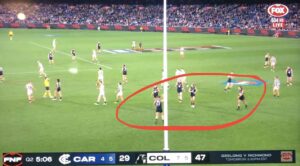
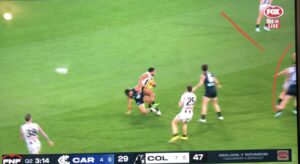
Granted the Blues weren't a million % sure what the call was immediately after it was made but even once it was determined, then they were still too slow to react and reposition with 5 players still facing the ball and another standing on the spot giving the ball back. Compare this to the Collingwood players already turning to reposition while Q is getting up from taking the mark with that top right hand corner player being involved in the next phase of play.
#2 - DEFENDERS TURNING INTO OFFENSIVE OPTIONS

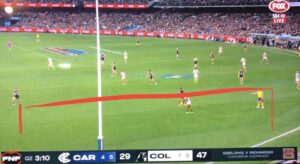
TDK has the ball directly behind the goal post and Carlton have 3 players who all started in front of him but have repositioned themselves behind where he'll take his kick! Weitering also starting there in the last frame so they're now playing 4 down in front of the ball against the best defensive team in the league - a very defeatist attitude to ball movement if there ever was one.
Collingwood on the other hand have already moved in front of the ball except for 1 player who is lateral to Q and about to get kicked to, so they are still playing even numbers from the ball carrier and out.
#3 - WIDTH
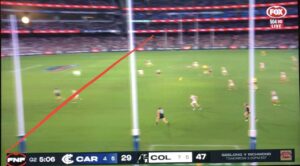
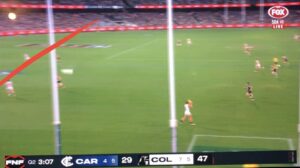
Off the back of reaction time but also system and the nailing of individual roles, you can clearly see the Pies have broken hard to get as much width as possible in the shortest time possible but there's also 2 Collingwood players breaking out for width v 1 for Carlton, so the Pies have options to continue to move the ball if they can work the numbers game to their advantage, which they normally do.
#4 - HARD SPREAD

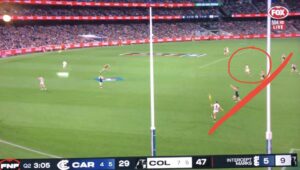
Off the back of poor reaction time and width, the Blues haven't been able to create a gap between the widest line and the next line of players pushing across the ground which doesn't enable them to keep the ball even somewhat central. They also don't have anyone spreading hard across the ground to provide that central option either, forcing them lateral again, but with nothing to go to down the line and Haynes choosing to handball instead of kicking, thus keeping the play live, it has taken away any delay time for the lumbering Blues midfield to make their way from 1 side of the ground to the other
The Pies break hard wide, much wider then the Blues, and they also have a player leading the charge from the next line of players, getting himself in front of 3 Carlton players, and into the crucial pocket of space opened up by the wide running Collingwood players. Houston can easily pop that kick in for an uncontested mark, the Pies maintain possession and field position - pretty much everything the Blues couldn't do.
#5 - OUTCOME
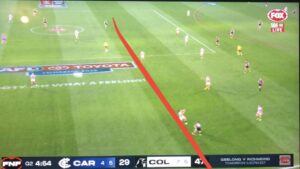

After detailing the process behind each team's rebounding efforts, let's look at the outcome.
After the Blues failed to react fast enough, couldn't spread wide and hard enough to create receiving players in dangerous spots, they then couldn't even manage to reach the half way point of the ground and literally just gave the ball up under, at-best, moderate pressure.
The Pies reacted much faster, spread much wider and harder, and were able to free up an option in a dangerous part of the ground to then move the ball from deep in their defensive 50 to an out of bounds spot about 40m out from their goal without the Blues even touching the ball.
Now when you keep hearing out of Collingwood that "we're a system-based team" and "everyone has great clarity on their role in the team", this is what it looks like - quick transitions, optimal player positioning = faster decision making time from a shared mental model of how the game is to be played.