The Lions are somewhat up against it after playing 23 games or more per season and going deep into finals for 5yrs now but it's come at the best time so I've no doubt they'll stay afloat during this injury-ridden time period and then be fine come the back end of the season.
The Saints season has not started like they wanted and although I'm not too up in arms about their off-season investments, they've already lost to 2 teams who are fighting for similar ladder positions come the season's end (Collingwood/Melbourne) + an undermanned Brisbane team at Marvel meaning they're going to have to win some major upsets going forward.
The less said about Essendon/North Melbourne/Carlton the better and I like the Demons this year but they're a play-in team at best although almost a must-watch team now with Kozzie Pickett about to have a NAS-type season.
Not that anyone wants to be peaking in round 3 but there's a lot of teams with high expectations just getting by at the moment.
Geelong have been flogged by Gold Coast, had a huge come from behind victory over Freo and this past weekend just got over an offensive-allergic Adelaide but they're also blooding youngsters like O'Sullivan, Dempsey, Wiltshire, Neale, Edwards, Humphries, Bruhn and Clarke.
Adeliade have not got the memo for playing AFL footy in 2026, reaching scores of 93, 88 and 60 from an inside 50 count of -32 over the season. It's too slow and they're really missing Dan Curtin who can win 1v1's through the middle of the ground at 197cms but they need to really shift their philosophy around ball movement. For what it's worth I had them sliding this season anyway.
The Pies are boring at the moment but winning is winning and defense will keep you in almost every game you play but you need both sides cause they're not the come-from-behind types they used to be, no matter how much the TV commentators tell us they are. How they can defend teams like the Suns and Dogs to half their score while scoring above their own average remains to be seen.
GWS have been fighting the injury battle for months already and although I like their kids, they still are too thin through the midfield which can't be hidden with key defenders and forwards out of the team. If there's a great time for around 4 bye, then it's now for the Giants.
Over the first 3 rounds, AFL footy has undertaken very noticeable changes in how the game isa currently being played.
Whether this will hold is not entirely clear but the rules have been altered to do so at some level and a good amount of player damage has already been done with an extremely high risk of secondary occurrences of hamstring injuries after the initial one - poor Callum Ah Chee is on his 3rd since Xmas already! (cue the image from Useless AFL Stats!)
For a multi-faceted sport like Aussie Rules, it needs to be looked at through a multi-faceted lens.
I like to use the 4 co-actives of performance to do this:
Tactical
Physical
Technical
Psychological
Tactically, we can clearly see the shift in play with a lot less stoppages and more continuous play.
This tactical shift can have an effect on the physical co-active as with more high-speed running comes more fatigue - low/medium speed running won't really shift fatigue markers in elite athletes.
The next flow-on effect is to the technical co-active as with fatigue comes sub-optimal movement patterns and players can overreach from less-then-stella positions.
But what about the psychological co-active?
Why has this not been mentioned at all?
It's definitely a black hole in daily media reporting as it's not visible and cannot be tracked by Champion Data and alike.
Enter Cognitive Overload.
Cognitive Overload occurs when a players' working memory gets overflowed by information from the environment which occurs in high pressure situations with great consequences.
In 2026 the game is far more open with tackles, clearances, ruck contests, ball up/throw ins, repeat stoppages all down with disposals, meters gained, marks all up.
More open play = More information to process = Less time to decide and execute in
Less stops in play = Less in-game rest = More high-speed running under relative fatigue
Cognitive Overload is definitely playing a part in this as well and couple that with dual tasking (performing multiple tasks at once) and attention can be pulled in too many directions, adding to this cognitive overload even more.
The simplest way I can describe cognitive overload in terms is through practice games and/or round 1.
Practive games are the hardest games from a physical standpoint as it's usually your first bout of continuous contact and has far closer game-simulated running then any training game can have.
You can do all the running you want but it doesn't compare you for the contact and 3 - 4 decent tackles can take the stuffing right out of you.
Round 1 is different all together and although you've had the contact in the practice games, what you haven't had is the extreme level of arousal and this another major component to cognitive overload and is why it seems you haven't even trained once 7 - 10mins into the 1st quarter of the 1st game.
Even AFL teams struggle with this as players are always saying practice games aren't even close to the real stuff, much like training game-sim isn't even close to the practice games.
There's a lot of focus on running loads and the like and I don't know if they do already but if they don't, then AFL teams should try looking at interaction load and how many at the ball, near the ball and far away from the ball decisions are made by players and try simulating that at training along with the running demands they already know about.
Soccer has some software around this sort of thing I believe, and I'd be surprised if something similar wasn't being used in the AFL to some degree.
Despite scoring the most points in the league and the 8th best defense, they still couldn't make finals, going 2-9 against the other top 9 teams.
Unless you're a bottom 6 team playing the top 6 - 8 teams maybe 4 - 5 times a year, then not beating any of them won't allow you to ever make finals and you'll forever be stuck in the middle.
In 2025 they beat 3-borderline finals teams by 11pts or less (Carlton by 8, Sydney by 11, Melbourne by 6) while losing to 6 top 8 t4eams by 15pts or less (Colingwood by 6, Gold Coast by 14, Geelong by 14, Adelaide by 11, Brisbane by 10 and Fremantle by 15).
Going into 2026 it was all about what their defense would look like and can they beat the top teams.
After not bringing anyone in specifically to shore up the backline, it didn't look promising from the outset until we saw them in action.
It's not like they need to drastically do anything defensively as they were OK last year but they needed to find a way to be better against the better teams during transition defense.
So far in 2026 they're averaging only 5pts more than last year and allowing 3 more points against but have a 3-0 record and already having beat probable top 8 teams in Brisbane, GWS and Adelaide with 2 of those being away games.
They won 8 games by 72pts or more last year and with an improved defense I shudder to think what those scores will be in 2026!
I made a quick 5min video detailing what the Bulldogs are doing which is nothing ground-breaking but it works for their playing group rather than the players having to fit the system and requires excellent discipline in spacing.
From a local football point of view, there are many times where you'll be outgunned in 1v1's in your forward 50 and something like this could help you tremendously such is its simplicity.
Given, potentially, the bottom 5 teams in their 1st 6 games, the AFL set them up to start with momentum and then see what they can do with it.
Losing on just the 2nd game to the Eagles certainly put a stop to that, at least for the time being.
The Eagles have been slowly revving their game style up to that of Andrew McQualter and even though the results haven't been there, their KPI's to how they want to play definitely have.
Pressure, ground balls, forward surge and territory is their blueprint - taking a huge leap out of the Richmond playbook through their premiership years, and now it seems some of their draft picks seem to be coming along for the ride.
West Coast still might finish 2nd bottom this year, and they'll be better than their record actually suggests I reckon, but North must be very disappointed to allow a 60pt turnaround in this game - and so they should be.
The dominated hit outs 54 - 27 but only marginally won clearance 46 -37 and once it turned into a chaos game, then North will be North.
She was a fast start to this one with an 11 goal 1st quarter with Sydney getting the game to look like they wanted it to, scoring 3.1 from turnover and another 3.0 from clearances (8-5).
After that though the Hawks made all the adjustments that mattered and just took it away from the Swans ending with +64 possessions, +43 marks and their back 6 having 46 intercept possessions showing out very poor efforts going forward.
The Dogs look outstanding with a better defense but their offense is also better than last year which is a truly frightening prospect.
The Giants are going to be inconsistent this year with the outs they have the young replacements they have in instead, at least until some of those injured players get back anyway but the Dogs under the lid could be the hardest trip in the AFL this season.
The Swans were looking as good as the Dogs until the news of Gulden's surgery and 3 - 4 month recovery time came through although our revamped game time and development of some players from the injury-riddled part of last year has me thinking we can handle his loss better the 2nd time around.
Injuries are the theme today it seems as we come to the Lions, missing 7 - 8 of their Grand Final team from last season in the early part of the season and no one's depth can withstand that and they've played the 2 best teams so far in the 1st 2 rounds so they'll be fine I suspect.
AFL in 2026 has come with a bunch of rule changes but also with a shift in how teams are moving the ball on offense.
Yes, the stand rule allows for play tempo to be maintained but teams are already on the run anyway, they're now just more confident continuing to go fast and not hold the ball up.
The biggest change for mine has been the use of handball through the center of the ground that some teams were doing previously (GWS/Hawks especially with their high half forwards) but it is widespread now and in a variety of ways.
Last week I highlighted how Sydney were using space through the center of the ground and I doubled-down on watching for it this round and it was pretty clear at times.
Like most tactics/strategies, once you see it you canlt stop seeing it!
Today we look at the following teams and how they are using the most important space in football today:
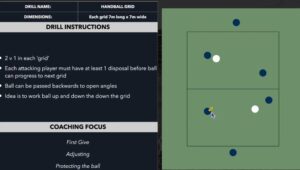
Coach AFL just put this up on their Facebook page today - a training activity (we've got to move on from drills that are predetermined and based on routine - language matters!).
They've been dormant for some time but have fired back up of the back of the Coaching Forum but it should never stop delivering to community coaches.
Here's the training activity:
The Positive's:
All players are involved all the time - no cones, no lines, no standing and watching
It contains information that represents the game - direction, ball, teammate, space/time constraints
Low complexity - the offense will have at least 1 clear free player to kick to at any given time, whether that's the other player in the middle area, the end line player or a player in the next half
The Negative's
There is no regression or progression to the activity
It provides a hard rule of having both players in the middle area at 1 end having to touch the ball before it can go to the other half which doesn't open up more options, it limits them, and that goes against what happens in games.
Pretty much every training activity I see, and that includes a lot of them I saw at the Coaching Forum miss maybe the most vital part of designing training activities - affordances.
Affordances are opportunities for action.
You receive the ball and there's 1 player covered and 1 wide open - the affordance for action is to play to the open player...but what if defensive pressure is closing in on me? That affordance for action is not as strong as it would be if there wasn't any defensive pressure.
In front of me is space, space that I can run and carry through and get away from that defensive pressure.
I now have 2 affordances for action - kick or run and carry.
What training must focus on is on players being able to recognise these affordances in game-like situations and it's that decision making process that carries over into games.
If you're coaching from the sidelines and telling players to kick the ball as soon as they get it, they will never see the affordance of an open player or space to run and carry through, really putting the onus of player development squarely on you, the coach.
The hard and fast rule of both players having to touch the ball takes away affordances the initial player might have which is to keep playing forward once they receive, rather than looking sideways or backwards to make sure everyone gets a possession.
A better way is to add a scoring system around this so if each player can touch the ball before transitioning then award 2pts for every transition v 1pt for a transition where they don't.
This keeps both options, and most importantly all affordances, open to be used as the ball carrier sees fit.
Here's what I would do with this to make it a more complete training activity by building this out.
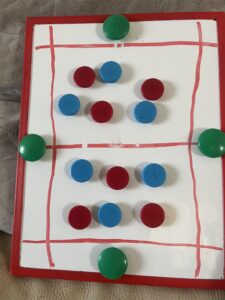
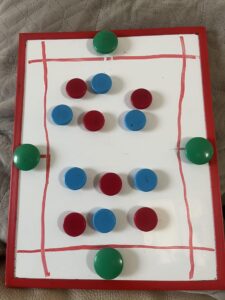
First, I need to settle on my intention and that can be the coaching focuses on the original image - first give, adjusting and protecting the ball.
I've never been sold on first give/first option as it's only the 1st option, it's not always the best option.
I'd possibly shift to a draw the defender towards you and then give and possibly keep it at that to really narrow the focus.
Alternatively, you can run at the defender if they are sagging off and make them focus on you, freeing up your teammate as well.
Going back to my Coaching Forum report from last week, let's use the concept and sill framework from Austin Stubbs.
The concept is drawing the defender and how to do that initially (wait for them, run at them, deceive) and the skill is the handball to your teammate (which hand to use, footwork, execution, outcome)
This might translate to only handball when the defender is within 2m of you and then seeing how they go about achieving that - you don't want to give the answers if they can learn them themselves which has greater learning retention then simply being told.
What might end up happening is a that the ball simply moves in a clockwise fashion as the defender will possibly always be a step behind being so disadvantaged.
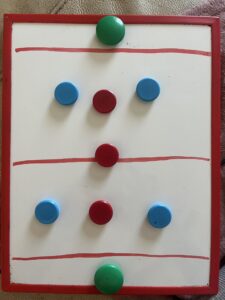
To break this pattern up add a defender to the half-way line where they can go from side to side but must remain on the line - the ball will now have to be moved diagonally at some point.
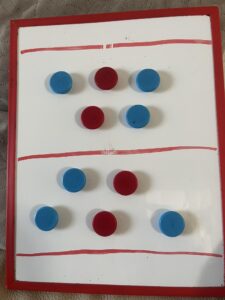
My next step would be to bring those end players into the activity and bring in another defender so it will now be a 3v2 in each half and you can make a handball count before the ball can be passed to the opposite end
Again, I'm still staying with my original intention and the cues around it - don't go away from them, keep the focus narrow.
Another aspect you can add in is that 1 player from 1 half can run and carry the ball into the other half to again open up the affordance of run and carry if it's there, and once they pass off then they simply return to their original half.
I don't do laps - unorganised coaches send players on laps.
To make organisation easy during the session think about how can build out your first training activity into something else in minimal time.
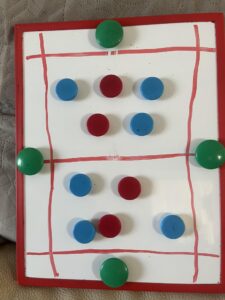
In this case we can add kicking into this by simply extending the playing area and shuffling a few players around.
Let's keep the 3v2 in each half but then add back in the end line player but also some neutral wingers.
The end line player can cover the width of the end lines to receive and the wings can cover the entire length lines to receive.
Each end is now essentially a 5v2 which is a low complex way to start.
As we've moved to kicking then the intention has to change but it doesn't need to be turned upside down as the same concept as before can be used with different cues.
In a possession game you want to move the defenders which is done by moving the ball.
With the stand rule back in effect you really want to make that defender have to stand, so you now take them out of the game until you've kicked the ball - this could be your intention: make the defense stand the mark.
Once you've forced them to that then moving the ball will be pretty easy as there's only 1 defender to cover 4 players.
Pretty quickly I'd suggest adding another defender to each end and possibly extending the area again as we still want kicking success.
A rule might use here is that only middle players can transition the ball to the other end, either to the middle and outside players or only the middle players.
Each layer slowly increases the complexity of the training activity which keeps your players on high alert, engaged and solving problem after problem and using the variability of repetition without repetition to do so.
Finally you can take the half-way line out and play 10v6 end to end full field.
Double finally you can then add more defenders in but if offense is your intention, then keep it a +1 or 2 on offense.
The pace of the game has definitely sped up for the time being although I suspect by rounds 5 - 6 coaches will have gone to work to slow it back down in an attempt to gain more control of different game variables.
In the meantime though, let's enjoy the show.
GWS completely stifled anything the Hawks wanted to do on Saturday afternoon, and with some clearance dominance (rare for GWS), we were able to witness what their team defense can actually look like when they're not defending from deep in their defensive 50...and their mid 50 trapping was very, very good.
The Dogs looked like they would continue the trend of not being able to front up against the big teams and even with Brisbane being +46 in disposals, +13 inside 50's, +6 in clearance and +47 in marks, what certainly looked like a Brisbane win by the stats, was turned away by the Dogs' back 6 when they really needed it with Lobb, O'Donnell, Khamis, Freijah, Jaques and Budarick managing 24 between them.
After the breakneck speed of the 1st 4 games, last night's boundary-fest was not the greatest watch. Both teams defend with the ball via low-risk ball options with a whopping 239 total marks between both teams - 223 uncontested!
The Pies have a system that allows for creativity via the Diacos Brothers and De Goey but when the Saints needed some flair in the last quarter, they couldn't make the shift but that's a staple of Ross Lyon-coached teams.
Today we look at:
GWS Team Defense x 2
Brisbane Kick Out x 4
Dogs Creating and Utilising the outnumber Advantage
That would have blown out a little bit more after the Blues skipped out to a 22 point lead after the 1st 2 goals of the 3rd quarter.
Enter McInerney, Heeney and Gulden with those stats for the 3rd quarter reading
Disposals +72, Contested Possession +40, Uncontested Possession +36 and the score +61!
21 clips from this game in 3 videos with the themes being Carlton getting overcommitting and getting stuck at contest, Sydney creating length to provide space in front of the immediate play to transition forward via handball and/or run and the huge difference in running power between both team's personal.
As normal the full analysis is part of a level 1 membership ($9/month) but I will post 2 of these videos from below to show what contest looks like in 2026 and it's a huge shift:
VIDEO #1
Sydney Kick Out
Sheldrick Not Continuing the Handball Chain
Carlton Kick Out
Wicks Not Continuing the Handball Chain
Gulden at Center Bounce Clearance
Sydney 666 Connection
Gulden Overlap
VIDEO #2
Carlton at Center Bounce + Chaos Play
Sydney Creating Space to Transition with Speed
Gulden Overlap Creates the +1
Carlton Going Corridor Without Being Set Up for It
Marc is at Collingwood VFL but is a high-performance tennis coach by trade with Austin and him having done this in a tandem for a while and it showed in their delivery.
This was again focusing on using CLA to drive how to you design your training activities which I've also written about extensively, so it was right up my alley.
My favourite nugget from this was Austin's framework of concept and skill where you need to be able to label both and if you can't then the training activity is probably not representative enough of the game and won't contain enough game information to transfer to games.
I'll touch on that in the 4th training activity presented below.
Austin went in to how when he was at Essendon and they tried emulating the Richmond chaos handball/surge game and this was what they used day 1 to introduce it:
2 DEFENDERS IN
A transitional handball activity with the constraints of time and space being progressively decreased for the offense as more defenders come in:
INSIDE TO OUTSIDE DIAMOND
A congested-driven activity that requires the offense to move the ball quickly and cleanly to the outside players to get the number advantage with the number players in such a tight area constraining time and space a lot for the offense, yet the defense needs to also adjust to having more players to cover as the outside players join the fray:
INSIDE TO OUTSIDE OPEN PLAY
Over a bigger area, this deliberately and specifically positions players from both teams to start with and then it's perceive and act for every player from there. I'll just add that if you only train in tight spaces where there isn't time to think and act, but simply to act then players will find it hard to perceive, think and act when they have the time to do so:
FORWARD PRESS DEFENSE LINE
Let's go back to the concept and skill framework from earlier.
In this training activity the concept is forward press defense and the skill is closing space effectively.
Going deeper on the concept, the why is to create a turnover as close to your goals as possible also recognising the triggers of when to use it which is usually once the first defender presses then the rest trade up an opposition player as well. Other triggers are the opposition receiving the ball facing our goals, a high/loopy handball receive or a fumble/loose ball.
The skill of forward press defense is how effective you are at closing space and then directing the player to an angle that will disadvantage them.
We're talking powerful acceleration into small/tiny steps to decelerate + angling the ball carrier towards the boundary line or another teammate coming into assist
What concepts you want to train up is the easy part but you really need to go to work on the skills required to carry it out repeatedly in the heat of battle.
In the end it weas a big but fruitful weekend and it should be mandatary for coaches and parents (especially dad's) to attend these typers of things in my opinion to increase the barrier to coaching which is THE number 1 reason for kids dropping out of football at any age and the sooner clubs realise this, the better.
This past weekend I attended the 2026 AFL Victoria Coaching Forum with countless other local men's, women's and junior coaches from all over at the MCG.
Should you attend in future?
Yes.
Sitting still is essentially going backwards.
I did a lot of the practical session's so and I didn't take any notes - this is all from memory so it's bit scattered but here's what I took from it.
COACHING GAMEDAY - WOMEN'S (SHAE SLOANE - HEAD OF WOMEN'S FOOTBALL MELBOURNE AFLW)
I only got the back end of this one as I was late getting there but she was covering the different aspects you need to address in the lead up to, and on. gameday.
This included what you want to do at contest and then on offense and defense.
The simplicity of it all might have surprised a few with the "line to goal" positioning mantra used on both phases of play to ensure they go the long way to goal on defense and that we go the quickest way to goal on offense.
Yes, it's predictable to them but it's also predictable to us (Geelong in the 2000's hitting the hot spot 300 times a game yet couldn't be stopped!) and makes perfect sense with Melbourne's past marking power inside forward 50 (Zanker, Harris, Hore).
Things to cover on offense include line to goal, best position (draw defender/cut to teammate), take grass, leading patterns, knowing what to do if you see a spare for either team, kick to advantage.
Things to cover on defense include line to goal, best position, 1st to move/transition focus, patterns (corrections), footwork, spacing.
On gameday you'd have 2 - 3 points of focus for contest, offense and defense depending on that game's KPI's:
Contest x narrow focus, 1st give, support/come back to the ball
Offense x attack line to goal, deep entries, roles in blitz/forward half play
Defense x defend line to goal, 1st to move/happy feet, roles in counterpressing.
I can add to this as the slides come through later but I'd most local footy clubs focus far too little or far too much on this part and simply need to find the balance of information v under/overload to keep retention as high as it can be.
Shae has been there and done that in women's sport having played high level volleyball and AFLW and now high up in AFLW administration.
Mon Conti has also excelled at football and basketball, often with both season's overlapping and playing both sports at the top level at that the same time so how she navigated that was interesting to hear - especially lying to her basketball coaches that she was also playing footy!
Daisy is 1 of 1 and she could literally talk AT me all day but she's as human as the rest of us, going into detail of how she was unsure of her relationship with a player last year and the worry it caused her and then how she dealt with it.
Her perspective on all things football, and especially women's, is like no other person in football at the moment that has the platform like she does and there should be more of it.
LIVE LIFE WHOLE - MEG DICKINSON
Live Life Whole is an online platform by women for women involved in sport that has gathered specialist form many areas of women's health and have popped them all in 1 space.
I've written about some of these issues before and with a lot of men coaching women's teams, this at least gets them thinking about more than just football when relating to their players.
This online platform needs to me made available to female players of all ages so coaches get to work doing so!
We've all had some experience with the Prep to Play protocol since it came to local footy clubs in the last 7 - 8 years and it's a constant work in progress to streamline the program to improve user-ability and to target what you need to in an ultra-specific way.
What's gone a bit sideways with PTP is that teams have used the same protocol for years on end when in fact there's level to PTP and you're meant to work through them and build your resiliency and robustness to the game of football.
Not that I want to start racing as soon as we start but one of my gripes with PTP is that is can be slow and engaged with not a lot of engagement from the players which can also mean it's not going to have its desired effect but seeing Brooke show how we can get it down in 10mins in a ramping intensity format has me back on board and I'll be adding the components I was missing straight back in for training tonight.
SKILL ACQUISITION - SHAE SLOANE
This was a practical session straight up at 9am Sunday morning and was highlighting the use of constraints in skill development 9sound familiar?).
She, and other AFL Vic Game Developers, all mentioned things I've written about over the years like repetition without repetition, differential learning, variable practice, challenge point, game representation and incorporating a constraint-led approach to training and had us try it out ourselves as well as showing some ways they do it at Melbourne.
It was great to see this stuff finally making its way from the AFL down to community level but that was only about 40 coaches out of the 1000's in Victoria alone but you got to start somewhere.
I saw ads for Game Developers a while back and now that I know what it actually is, I have asked for more information on becoming one.
In small groups we had to move through various stations and develop a training activity with the equipment at each station where we had 1 station of nothing but 3 tennis balls but when you know the principles behind CLA, then you can do this far easily then if you don't.
During your warm-up you want to incorporate some form of quick reaction/decision making straight away and get away from partner handball with slow/low intent handballs and 10min chats about the weekend.
For quick reaction it might be as simple as 3 kicks each in a race with the other partners to ramp up intent.
For low complex decision making it can be as simple as this by incorporate repetition without repetition by having the defender give the ball to the kicker in as many different ways as possible (roll, up in the air etc) and/or the kicker having to do something with the ball before they kick like pass it around their backs, under 1 leg etc:
RUCKS AND TALLS (STOPPAGE SET UPS/SYSTEMS + ROTATIONS/TIMINGS) - DARREN FLANIGAN
This was fun as Darren is old school Geelong ruck from the 90's and 90's and is as throwback to those days.
I only did half of this but 1 thing I took away was how to use your body at contest whether you're a big or small and that's to give them a shove 1st to knock them off balance but nothing silly, step across and in front of them with the leg closest to them, then use your closest elbow to hold them out as they try and come back to you and the ball:
Jodh was an innovator in the women's space, setting up kicking masterclass for female footballers as far back as 2014.
A high energy speaker, he was very engaging and had plenty of little gems on teaching kicking such as young girls initially trying to kick from their quad only (that can lead to overuse injuries as well as poor kicking distance/accuracy) and talked a bit about using basic leg swings to groove the action you want them to use as well as using a traffic light analogy:
I would like to see a lot of what he said combined with more external focus though v internal focus.
DEVELOPING GAME PLAN + OFFENSIVE STRATEGY - JACKSON KORNBERG (FRANKSTON DOLHINS VFL)
This was a very well-done presentation with just enough information to cover a lot of area's without getting bogged down into too many specifics.
Once again it was the simplicity that stood out but to be clear - it's probably highly technical when a coach lays it out for themselves but by the time it gets to the what the players get to see, it has been streamlined to an inch of its life with only the necessities remaining for ease of consumption and retention.
I liked he connected stats they use as KPI's to their game style, suggesting that your brand is crucial to sustainability and if your stats are maintaining or increasing, then you're on the right track.
He also posted a pre-xmas slide from a season or 3 back that shows how they introduce concepts from session 1 onwards.
Week 1 - Fundamentals
Session 1 x Hands in Tight + Session 2 x Kicking Club + Session 3 x Kicking Club
Week 2 - Flow
Session 1 Face Up/Fight Forward + Session 2 x Outnumber Game + Session 3 x Fight for the Outside
Week 3 Smash
Session 1 x Charge/Go Forward + Session 2 x Recover Back + Session 3 x Close Out/Deny
Week 4 Smoke and Flow
Session 1 x Outnumber Game + Session 2 x Recover Back/Own 1.5 + Session 3 x Intro to Transition
Week 5 Transition
Session 1 x Fight Forward/Transition + Session 2 x Fight Forward/Transition + Session 3 x Fight Forward/Transition
2 training activities he has on his slides were:
DIAMOND KICK
Go for 1min sets, not 3 - 5mins as I say in the video with the focus points being footwork for the outside players, use 1st option and don't force something inside that's not on
SEARCH AND DESTROY
Focus points being to face up and fight forward for the offense and to press forward and spare the deepest opposition for the defense.
Last year I discovered a Twitter account called One Percenters which is actually a guy named Mateo Szlapek-Sewillo - a footy analyst who provides THE BEST season previews in all of AFL-media print, screen and audio.
I've linked to him before and with his permission I have started to put together some AI-generated graphics on each tea based of his preview of each team.
Today we'll cover Adelaide, Brisbane, Carlton and Collingwood.
Week 1 of the practice games, or should I say match simulation, is over with and things get a little more real with official practice games this week before the real serious stuff.
I watched WB/Syd live and got sunburnt to a crisp but we (Swans) looked good and the Dogs were more than serviceable without a crop of their stars on the park.
The same holds for the Pies who were without most of their starting 22 but GWS had the week from hell in the lead up to the weekend and were also missing a few of their starters.
Some of the camera angles don't allow for a lot of the ball vision to be seen so I've got a lot of center bounce clearance clips.
Last week Sam Mitchell caused quite a stir when he admitted to using AI in his coaching process and although what was reported contained very limited detail of what he actually uses and what he uses it for, the uproar was ridiculous.
There is no doubt that AI will become a part of Aussie Rules in the near future as team's are always looking for ways to optimise and streamline their approaches and there's not an easier way to do that then through AI means.
Can machine learning models based on technical performance and not score margin, predict match outcome in real time?
All models performed well (73.5 – 75.8% prediction rate) v benchmark score-based model (77.4%) with accuracy being at its lowest at the start of the match (45.7 – 48.8%) and increasing to peak near the end of a match (87.2 – 92.7%)
A DSS is a computer system designed to support the decision making of the user
A handful of technical PI’s are able to predict match outcome from 78.9 – 95.1% but the models weren’t designed for in-game us, only pre/post-game
Wanted to test other metrics but scoring-based one’s and opted for meters gained, meters gained per kick, time in possession, inside 50’s, turnover’s, time in forward half, contested possession, effective disposal, groundball gets, marks on lead and rebound 50's
Transition stats x intercept from mark, defensive 50 rebound to boundary %, defensive 50 ball movement to wing %, defensive 50 ball movement to corridor %, turnover’s
Data should guide you with what to do, not just tell you what to do
Suggestions were made for it to dig deeper so they added an insights option which provided breakdowns of the subcategories of PI’s contributing to the broadly defined PI’s which formed the suggestion and the coaches liked it
What might be best is a combined approach where coaches provide a list of specific changes they might make during the game or have made before, coupled with their pre-conceived expectations of the way these would impact the values of their PI’s and instead of suggesting numerical PI targets, the AI could then suggest a small selection of these specific changes which would satisfy the teams needs according to the coach’s preconceived expectations and then the coach picks the most appropriate change in the moment
Long term, data can be collected on the actual impact of these changes and this database could be used to provide more objective actionable suggestions
Decision-making stages AI could support include opportunity trigger, understand the opposition, determine the need for action, explore options, evaluate the decision
Impact AI could have on decision-making constraints x manage information volume, reduce emotion, reduce time pressure, prompt early coach reaction, direct focus
An AI-based DSS should update regularly, be easy to navigate, use color, be customisable, be transparent in its confidence, provide the ability to manually dig deeper
Coaches respond to an opportunity trigger, they endeavour to understand the opportunity and then determine the need for action
If action is required, coaches explore options, take action, and then evaluate the decision
AI can handle far more information in time-constrained environments than humans and can pick up on patterns not recognised by the coach
Coaches should consider opportunities within current in-game decision-making/coaching practice’s where they would be willing to be supported by AI and communicate this with those responsible for building the DSS, use the discovery of context specific decision-making processes as an opportunity to reflect on your own practice by asking yourself: h
How am I becoming aware of an opportunity?
Am I truly considering the underlying cause of the opportunity before deciding?
Is taking action always necessary and how do I assess whether action is necessary?
Where am I sourcing my options from and am I leaning on the experience of others around me to support the exploration of options?
How/when do I take action and is my message getting across to the right people in an effective manner
How do I evaluate whether a decision was the right one?
The discovery of context specific decision-making constraints during matches serves as an opportunity to minimise some of these constraints through means other than AI so ask yourself:
Are there any ways that I can improve the way I communicate my thoughts to players/assistant coaches?
What impact does emotion have on my ability to make good decisions and how can I be more objective
What are the most important pieces that I want to be fed during games and have I communicated this effectively to my coaching team/support staff?
Work closely with analysts to find common ground on the types of DSS based solutions you think could be useful and provide feedback on any barriers you face when using the DSS
Give a DSS time to evolve, communicating with the developer about what would help build trust in the system
For analysts you are the conduit between the DSS and the coach and its effectiveness will depend on your communication of suggestions from the DSS to the coach, work closely with the person designing the DSS and provide suggestions for improvements + understand the underlying processes/technique involved so you can adequately explain suggestions
For researchers/practitioners/analysts aiming to design/develop/implement a DSS to gain an in-depth understanding of how coaches make decisions in their environment, you need to:
Build a DSS that fits their current processes
Consider ways to incorporate additional data types to improve on the current method
Work closely with coaches/analysts and consider the implementation of a DSS as a continuous process
Ensure the suggestions the DSS provides are sufficiently actionable for the coach
Be willing to compromise on perfect science to provide a DSS coaches will find most useful
Any new system will be competing for attention so incorporate desirable functions of older/pre-existing systems into the new DSS
Interesting game for a practice hit out last night.
For me I wanted to look at Brisbane's ball movement which I covered in detail here in which I will be constantly referring to in any Lions videos this year.
My best mate is a Blues supporter so I'm somewhat interested in them as I have to watch them live a couple of times a year when he comes up but also a local boy from down my way and an ex-teammate's son Taylor Byrne was playing so I was very keen to see what he would do and he didn't disappoint - kicking 3/.1 all in the last quarter to get the Blues over the line.
This will be broken up into a Brisbane part and then a Carlton part.
BRISBANE
After going through numerous Brisbane games late last year, and same as watching/analysing Sydney and Collingwood games previously, it's impossible not to watch them play and pick up on the trends I've identified in their respective products (Sydney, Collingwood).
In Brisbane's case it's short kick possession football, patience with the ball, hit up leads and getting length towards goal of which all of these are touched on in the video + the companion video I alluded to.
CARLTON
As mentioned in the video the Blues are a big work in progress as they turn their list and game style upside down and this video shows a clip of the "good/new" Carlton but then the "old/crap" Carlton rears its ugly head as well which will be their vibe this season I think but at least there's a conscious effort to change unlike previous years of going to the contest well over and over again.
Last week Sam Mitchell caused quite a stir when he admitted to using AI in his coaching process and although what was reported contained very limited detail of what he actually uses and what he uses it for, the uproar was ridiculous.
There is no doubt that AI will become a part of Aussie Rules in the near future as team's are always looking for ways to optimise and streamline their approaches and there's not an easier way to do that then through AI means.
Information that needs to be collected from coaches before building a suitable DSS are what's your background/experience? How long were in each position? How did they lead to your current role? What different types of decisions do you make during games? Why do you see them as important/necessary? What factors impact those decisions? What information do you rely on to make game decisions? How does that information help you do that? Do you use either internal or external sources of information? Describe a specific decision you made in a game and the process behind it? How did you identify the problem? What did you do next? How did you evaluate the decision
Opportunity Trigger refers to data, coach observation, intuition and momentum
Momentum can be identified through objective (you can see it) and subjective means (a change in pivotal stats, quick shifts in scoring, field position etc)
Understand the Opposition refers to looking for context, experience, using data as evidence and involves searching for more detail/why is it happening to make an informed decision
Coaches will use data to reassure what they’re seeing is correct
Determine the Need for Action refers to the fact coaches can’t control some things and sometime doing nothing is the best method as players play well or play bad in any given game which is again out of the coaches control
After an uncontrollable factor causes a problem, it’s better to consider the players intention in the moment and keep going
A key aspect of a head coach’s decision making is to find the balance between when to and when not to change things up and where that balance lies may depend on the coaches philosophy/belief in the capacity of the players to solve a problem on their own even though a lot of coaches favour immediate performance benefits over valued learning outcomes for players during games
In the end, the determination for or against change either halt the decision-making process (no change) and reassess layer or change (proceed to the next stage)
Explore Options refers to sourcing options, action types, weighing up the value of action
Coaches want to hear the ideas of others in this phase of decision making
Coaches will rarely do things they haven’t at least talked about during preparation
When you solve 1 problem then another opens up – there’s a cost to every decision
When selecting an option that is good enough there is a tendency to go beyond picking the next best option and through explicit consideration/calculation or risk/reward, the exploration of options represents a coach’s best attempt at reasoning within their constraints
Take action refers to the head coach having final say + frequency/timing of decisions
The coach's role is to facilitate the decision-making process collaboratively and they then must filter all the information and then assume sole responsibility to make the call
Avoid sending messages out in the last 5mins of a quarter so you can properly deliver it at the break
Evaluate the decision refers to the fact that not every decision is right + consequences of getting decisions wrong + time to evaluate
You'll rarely win from making the right decision/s but you can definitely lose if you make the incorrect ones
You have to allow time for 1 change to work before making another
Coaches can make rapid, pre-emptive decisions to allow a more considered decision to come later which is 2 subsequent decision-making processes (1 rapid/1 extended) where the evaluation from rapid leads into extended
Barriers to A.I decision-making study
To minimise decision-making constraints, you could develop/implement a DSS system
Information that needs to be collected beforehand includes what barriers to effective decision-making do coaches face during games? What are the thoughts/perceptions of coaches towards A.I based DSS’s during games? What are the visual functional design elements which would enable coaches to utilise/interpret information provided by a DSS?
A hypothetical might be a scenario where we're down at half time, we don’t know what’s going wrong or what can fix to improve our chances of winning
At half time we use the DSS by adding in instance 1, import live data, observe interface and then read the suggestions
You'll also be able to navigate the simulator tab and play with a stats toggle to simulate what different changes in your stats will do to your predicted chance of winning
Barriers to decision-making include cognitive deficits via coaches emotion, delayed reactions/misdirected focus
Environmental deficits via time pressure, difficulty in communication, the physical environment (up in the coaches box v on the bench) and information volume
Cognitive barriers to decision-making constrain the decision-making process internally via coaches experience and cognitive limitations
When emotion develops into a barrier then you need to catch your breath and stop and look the wall/have a drink to shift your mind away from what you’re actually seeing
Coaches expressed they sometimes identified potential options but refrained from implementing them due to their concern that their communication of the message would be ineffective
Without a collaborative, calm environment, the ability to make decisions in a rationale/collaboratively way is hindered and there’s less psychological safety around incorrect decisions
Coach Thoughts/Perceptions on DSS included an un/willingness to adopt (replacement/hesitancy), expectations (ease of use/what coaches want), concern/criticism (oversimplicity/overreliance), the actual DSS role (when and how/who and why)
Last week Sam Mitchell caused quite a stir when he admitted to using AI in his coaching process and although what was reported contained very limited detail of what he actually uses and what he uses it for, the uproar was ridiculous.
There is no doubt that AI will become a part of Aussie Rules in the near future as team's are always looking for ways to optimise and streamline their approaches and there's not an easier way to do that then through AI means.
During games coaches face limitations to available information and cognitive capacity (calculating risk/reward)
A decision support system takes complex computational methods and empowers the user with them in an interactive/easy to use manner
Can pinpoint in-game performance indicators and their relationship to success in that specific game
Phase 1 x exploration of in-game decision-making of AFL coaches
Phase 2 x develop a decision-support systems (DSS) to leverage AI/Performance Indicator’s (PI's) predicated on the insights gained from phase 1 to support coach in-game decision making
Phase 3 x deployment/implementation of dss with AFL clubs to evaluate DSS impact
Decision making is intertwined within the coaching process in both participation/performance settings
Coaching is built on a cyclical relationship between information, knowledge, skills of the coach, athlete's capabilities, performance analysis, competition and preparation, all that require elements of decision making
The need to make complex decisions to fit the problem at hand may result in some parts of the coaching process receiving more attention than others
Coaches employ naturalistic decision making, consulting common sense models developed through experience with the premise of decision making being that decisions emerge from a subconscious process of scanning the environment, recognising a decision problem (a mental threshold is triggered) and consulting knowledge stored as mental models without explicit reasoning resulting coaches using mental simulation/consultation of previous matching decisions from decisions in time=pressured situations
All decision making requires ongoing situational assessment that triggered some form of action which suggests that there is more to coaching than experience/intuition and it relies on the idea that the formulation of decisions still rests heavily on the cognitive processes of coaches
Coaches should consider their decision-making environment
In complex situations, individuals trying to make rational decisions (based on reasoning) usually end up making satisfactory ones but not the optimal one because rationality is constantly bound to the interactions of cognitive/environmental constraints = suboptimal/inconsistent decisions with making the right decision being heavily dependent on the information available and how well a coach interprets it
Cognitive constraints (memory, heuristics, knowledge, problem solving ability) + environmental constraints (sport science, assistant coaches, performance analysis, athlete monitoring technology, available information) = rational decision making capabilities
Inconsistent decisions will be made based on instinct alone
Coaches need to consult with both cognitive/environmental constraints to make informed decisions
Machines can process larger/more complex loads of information than humans and more rapidly
Human data collection can be inconsistent from different interpretations
PI’s are quantitative measurements of action variables that aim to define different aspects of performance and they should form the basis of analysis
Research in AFL found that winning teams were different to losing teams with regards to 14 out of 16 analysed PI’s including greater values for kicks, handballs, marks, inside 50’s, un/contested possessions and tackles
In AFLW, PI's were disposal efficiency, kicks, marks and uncontested possession = winning
Coaches can use data to make decisions to maximise/minimise certain PI’s
Rather than using PI’s to compare un/successful performances, use PI’s to group players into positional roles
PI’s related to ball winning, ball use, hit outs, defense and negative performance can allow coaches to identify players of a desired positional role while supporting recruitment/selection decisions
Feedback can be categorised by valence (positive/negative), prescriptive (information on how to change performance)/descriptive (described performance) + content/audience
Post-game feedback retention from players is low possibly from being ineffectively delivered and it is more often descriptive v prescriptive which allows athletes to self-regulate their response to feedback in a way that is conducive to learning
Rather than trying to immediately correct performance, the coach is afforded time during the week to consider the best way to correct performance through further feedback/training design
Pre-competition feedback should be targeted towards decision-making by facilitating knowledge creation so they need to allow players to solve problems independently while guiding them in the right direction
Training is the time to manipulate the quantity of feedback to develop problem solving abilities with pre-post competition feedback focusing on providing players information they need to form their own decisions
AFL has a runner to deliver messages with 81.3% being prescriptive and 58.4% were controlling in nature where coaches pressured players to think/act in a certain way = a higher proportion of prescriptive feedback v other sports
Coaches send out 15 messages/quarter with the highest amount coming at times when the game is undecided and significantly lower in games when the game was "over"
Expert decision makers recognise cues/patterns quicker than novices but are still limited by the information processing capacity of humans and machine learning can combat these limitations by finding patterns that the coach doesn’t have time to and decreasing the need to analyse raw stats and have more time to apply expert judgement with a higher standard of information than previously
Decision trees classify outcomes by splitting the data on features that provide the most information about an outcome until splits can no longer be made such as meters gained relative to turnover’s forced score relative to time in possession relative to win/loss + meters gained relative to turnover’s force score relative to win + meters gained relative to turnover’s forced score relative to disposals to win/loss
Trees terminate the splitting process when a selected information threshold/tree length is reached
Of 97 PI’s available for analysis, decision tree model accuracies were as high as 88.9% for finding the most important PI’s to winning being meters gained, inside 50’s per shot on goal, turnover’s forced score and time in possession
Although accurate/easy to interpret, they can be too simple to provide great insight into performance
Via a generalised linear model, score margin was predicted on average within 7.4pts with the most important measures being inside 50’s per shot, inside 50’s and rebound 50’s
Converted to win/loss outcomes, generalized linear model sits at 95.1%
Technical PI’s can explain performance just as good as tactical PI’s but tactical provides a more unique insight into performance
Cognitive constraints (coach's perception, memory of events, philosophy, opinions) + environmental constraints (live match stats, athlete monitoring technology, information from assistant coaches) + suggestions from decision support system all go to the coach's mind = decision is made and communicate to players
To make a DSS these question’s needing to be answered include how do coaches make decisions in competition, what barriers to effective decision making do coaches face during games, what are the thoughts/perceptions of coaches towards the use of AI-based DSS’s during games, what are the visual/functional design elements which would enable coaches to utilise/interpret information provided by a DSS, how efficacious are score agnostic models for the prediction of end-match outcomes in games, which variations and what type of model is the most useful for supporting coaching decisions during games, when implemented in the field what is the impact of an in-match DSS on coach decision making during games, how does the way a DSS is used change throughout an implementation, what are the elements of a DSS or its implementation process which contribute (positively/negatively) to the uptake of the system…
In-game decision making consists of 6 stages x opportunity trigger, understand the opportunity, determine the need for action, explore options, take action, evaluate
Bounded rationality, an extension of rational choice, describes the process that coaches employ to make decisions with the outcome of the decision dependent on the interaction between the available information, their own cognitive limitations/biases and the finite time in which they have to act and given the same decision making prob, it explains how different coaches can come to different right decisions
Coach decision making study - bounded rationality highlights the benefit in having access to the best possible information/environment with masterful mental capabilities (perception, knowledge, metacognition) when making decisions
A common framework for understanding the decision making of sport coaches is naturalistic decision making and it explains that in time-constrained decision making environments, expert coaches will scan for/attend to key attractors/recognisable patterns in a continuously unfolding environment, framing a decision problem if a mental threshold is reached
Key attractors immediately lead expert decision makers to a simply matched solution in most cases though they search for additional cues to diagnose the problem if an immediate solution is not recognised
In some cases, a stored solution may not match the present problem leading to mental simulations of potential modifications to solutions from previous experiences to evaluate their applicability to the present problem
Coaches have more time to make their decisions in v players/umpires and therefore can engage in more critical reasoning
I think most of us weren't sure how this game was going to look and turn out to be but rest assured it was more than worth it, and something that can easily work in the long term.
On paper the Vics looked ridiculous and not that WA were any slouches themselves, but a midfield group of Bont, Butters, Diacos with a secondary unit of Serong, Merrett, McCluggage, Richards, Anderson and Rowell is stuff All-Australian teams are made of.
After a fast start for WA, they couldn't quite complete their numerous comebacks but the game was definitely competitive and how the AFL decide to rill with this going forward is anyone's guess.
When this was first announced might thought was to rotate teams as much as possible so that it's not always the Vics and then players like Bont/Daicos who would be in it every year start skipping years because the shine has worn off. If states plays every 3 - 4 years or so then that's 1, maybe 2 opportunities to represent your state so the hunger will be there every time it presents itself.
Unfortunately to make this a commercial success I suspect the AFL want it to be (and that's usually all they're interested in), they'll need the Vics in it 80% of the time.
From this game we look at:
Richards Wing Run
Buying Your Time for Your Midfielders to Reconnect
When you're still (trying) playing open-age footy at 47yrs of age then you'll search high and wide for anything that a) makes it easier to do so, and, b) could still provide additional performance benefits.
I have followed David Weck for a while now and although a little eccentric, it's probably passion more than anything else.
He has a very specific twist on performance training, having previously invented the Bosu Ball, of which I have one at home from years ago.
His latest product is the Pulse Power Vest that I received earlier this week and took it for a test spin yesterday of which I detail in this Twitter thread.
It wasn't cheap to get all the way over here to Melbourne but for an old athlete like myself, its potential for performance gains or at least maintenance, seems very high.
The way that it fits to you also means it's extremely versatile where you can take it with you where you want to (you pick it up in 1 hand pretty easily) and you can use it in pretty much any exercise you like, including skill activities.
Limitless potential!
Pumped for footy being back tomorrow night too by the way!!!!
These notes come from this study on elite Soccer players but the exact same information processing and decision making processes is required for footy.
Sport at any level requires a deep understanding of the game, rapid information processing and decision making, not just physical abilities
To close these gaps this study used elite soccer players and then focused on more psychological aspects of performance than other studies such as problem-solving, memory, executive functions and personality traits while evaluating via multiple means to get a comprehensive assessment
Elite athletes demonstrated heightened planning/memory capacity, enhanced executive functions - especially cognitive flexibility - elevated levels of conscientiousness, extraversion and openness to experience, coupled with reduced neuroticism and agreeableness
Non athletes report high elevated levels of neuroticism and agreeableness
Executive functions (high order top-down regulatory mechanisms controlling low level processes) are of great importance for success in ball sports as they make it possible to adapt and plan behaviour in a fast-changing environment
Design fluency performance correlates higher with national players then with Premier League players and those players are also described by coaches as the best readers in the game
Executive function and coach-rated game intelligence also correlates highly
The battery of tests they used were also able to predict assist/scoring behaviours + dribbling
Versus the control group, soccer players have better memory, problem-solving skills, are better at planning tasks, have higher levels of working memory, have superior efficiency in analysing situations/devising optimal strategies to achieve their goals in the same time frame, have the ability to plan several steps ahead in order to reach a goal quickly in a changing environment, reach high scores on temperamental scales such as persistence, harm avoidance and cooperation while also score higher on impulsive scales such as seeking sensation and positive urgency
Small group personal training done the right way. Train in a group - do YOUR OWN program. PT studio located in the heart of South Yarra on Surrey Road North, just off Toorak Road. 1on1 personal training also available. Don't do everyone else's program, get personal with your training.